
It's undeniable.
The more you discover the possibilities offered by nature, the more you want to enjoy them.
For the evolved biped that you are, contact with the ground has always been the secret to successfully exploring your environment efficiently.
And since winter often changes costumes with its dance of rain, ice, freezing and thawing, you need to find a way to keep your feet on the ground.
Because ice is insidious and can take many forms. It can surprise you on a city sidewalk as well as on a mountain trail leading to a summit, even in spring or fall.
Whether you're a fearless hiker or simply prudent by nature, buying a pair of crampons has almost become a survival condition for those who love being outdoors in nature.
In the following text, you'll find tips and advice for purchasing a pair of crampons that will allow you to move forward on any type of surface with the grace and confidence of a proud descendant of a species that has perfected the art of moving on two supports for millions of years.
Components and Types of Crampons
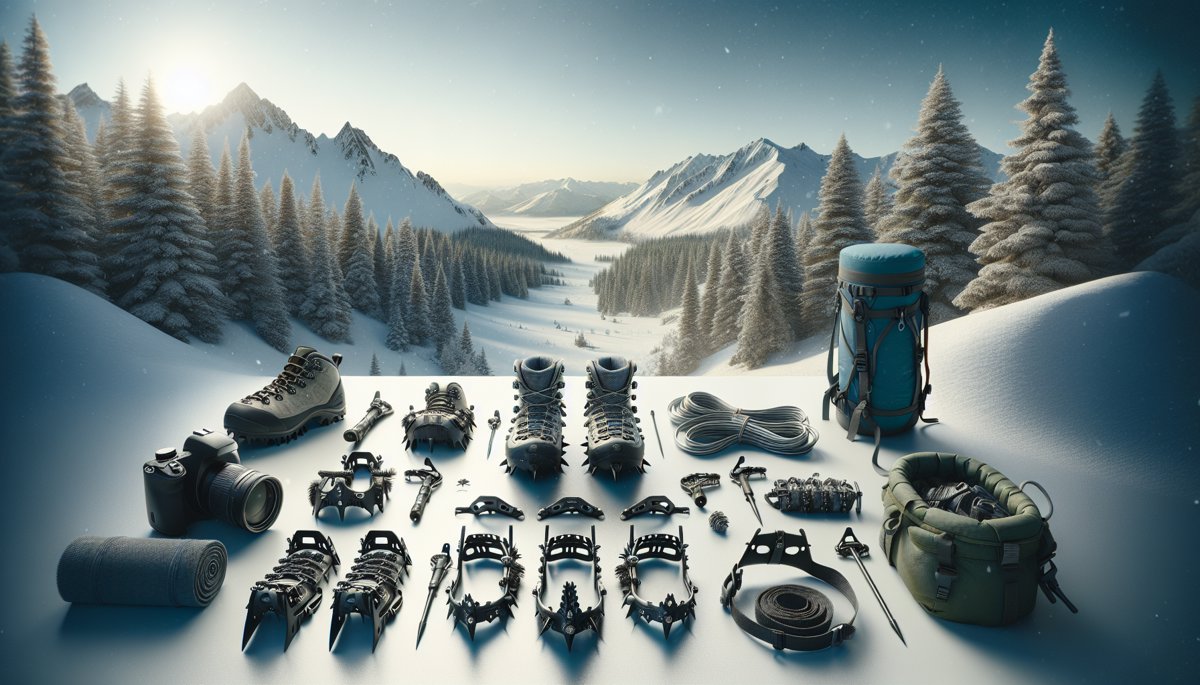
Most crampons on the market are designed to adapt to the boots you wear and the activity you plan to do. You usually find two distinct parts to a pair of crampons: the support that covers the top of the foot and the frame on which the crampons are attached and which goes under the sole.
To simplify things, we can divide crampons into two categories: flexible frame crampons and rigid and semi-rigid frame crampons.
Flexible frame crampons are made of rubber, metal and sometimes plastic. They are mainly used for running and urban walking or hiking on packed snow trails.
This category of short crampons is designed to offer light grip on flat surfaces and interfere as little as possible with the natural walking movement. They can be easily removed and put on without having to take off your boots.
Rigid and semi-rigid frame crampons are designed for all types of conditions. They can be used for hiking, high altitude, but also mountaineering and ice climbing.
The support that covers the foot of this type of crampon can combine rubber and metal, and straps allow you to adjust the crampons according to your needs.
Crampons for mountaineering and ice climbing are in a class of their own. They are installed on the boot using a rigid binding. Some boots are also designed to accommodate crampons that are screwed under the sole, others come with integrated crampons.
This type of crampon is longer and stronger, as its construction is intended for more unstable surfaces with variable density like snow, ice and even rock. Their design has also been thought out to facilitate vertical ascents on ice. They are recognized by the presence of spikes pointing forward. Not too obvious to move with this type of crampons at first...
Performance
Might as well get this in your head: impossible to choose perfect crampons! Since each type of crampon is designed for a specific use, performance criteria change depending on the activities you practice. Choosing the most efficient crampons often comes down to choosing a pair of crampons that is adapted to the use you make of them.
If you do urban walking or running, you'll want something light. For hiking, we want something more versatile, for mountaineering, something more robust.
However, we can evaluate performance by considering the surface area covered by the crampons. Some crampons cover the sole of the foot, but not the heel. The larger the surface, the better the grip on ice. The number of teeth, length and orientation of the spikes can also be characteristics that influence performance.
Lighter crampons are usually less efficient than heavier crampons, especially on snow, soft ice and irregular surfaces with variable densities.
Regarding more specialized crampons for mountaineering and high altitude, we mainly look at the arrangement of spikes, the quality of components and the efficiency of bindings to evaluate performance.
Comfort
On hard surfaces, the longer a crampon is, the less comfortable walking becomes. On a softer surface, short crampons are useless. You therefore need to have a crampon that corresponds to the type of surface you're moving on.
And since it can be very uncomfortable, even dangerous to walk with crampons on a hard surface like concrete or asphalt, it's important to mention that the ability to easily put on and remove your crampons can prove very convenient and in this sense become a criterion that influences comfort while walking.
The structure that supports the boot can also affect the comfort aspect. Some designs wrap around the foot more, which allows better distribution of energy in movement. There are sizes for crampons with flexible rubber structure (small, medium, large). It's important to choose the one that corresponds to the size, but also to the shape of our boots.
Rigid and semi-rigid frame models offer the possibility of adjusting more firmly with straps or bindings. The more precise and firm the adjustment, the fewer pressure points there will be under the foot, which makes the crampons efficient and comfortable.
A well-adjusted crampon becomes an extension of the boot, it's almost imperceptible while walking (okay, you still have to adapt a little).
Crampons that are too loose will tend to move. In addition to risking losing them while walking, crampons that are too tight can cause poor blood circulation and thus facilitate frostbite. And be careful on descents! Poorly adjusted crampons can cause falls.
Furthermore, soft or wet snow tends to stick under the foot with certain types of crampons. Know that it's possible to add anti-snow plates (Antisnow) to prevent snow from accumulating under the foot. This is a particularly interesting addition for long crampons. Some crampon models come with this addition at purchase.
Lightness
Weight is influenced by design and the type of materials used. Flexible structure crampons designed for urban use are minimalist and the weight difference between different models doesn't represent a determining criterion.
It's somewhat the same for long crampons. Some lighter materials that go into crampon construction like carbon and titanium can help reduce weight and make a small difference over long distances or in difficult ascents, but it's a factor that is relatively negligible in guiding your purchase.
In truth, it's not a few extra milligrams that will make the difference. It's better to focus your efforts on your physical condition to appreciate the contribution of a good pair of crampons.
Durability
Durability is influenced by the type of components that go into crampon construction and the frame design. Some crampons are not as durable as others due to the type of material used in their manufacture.
Plastic components should be avoided. In cold weather, plastic becomes brittle and breaks easily.
Semi-rigid chain crampons are quite popular because they are versatile and durable. Their durability is mainly influenced by the quality of the elastic part that supports the top of the foot. Some rubbers like special thermoplastic elastomer and tungsten carbide are more resistant to cold than ordinary rubber.
For rigid frame crampons equipped with bindings, it's the efficiency of their design that often makes the difference.
Versatility
Unfortunately, versatility often equals compromise. For purchasing a first pair of crampons, we choose crampons based on the activity we practice most often, even if it means having several options for different situations.
Urban crampons for walking safely to get to the bus stop or to go to work can do the job, but minimalist crampons will be insufficient and even useless if you have to walk on snow.
For mountain hiking where a fall on a steep trail can prove fatal, it's important to have a larger contact surface under the foot. We generally use longer crampons with a stronger frame. The presence of spikes under the heel is also an aspect that greatly helps secure descents.
There are versatile crampons that offer good traction on snow and ice. The spikes are shorter, but still offer good grip due to the number of spikes and their distribution which offers a large contact surface.
Price
Prices vary between $10 and $300, but you can find a good pair of versatile crampons for $50. In general, the more plastic and rubber there is, the more affordable the item. Low-end crampons (under $20) usually don't last more than one season and you have to buy new ones every year. This is definitely not a good investment for the outdoor enthusiast who wants to be in nature as often as possible and who wants to face all types of conditions.
We can invest in terms of profitability to evaluate the price of our investment. Since crampons don't constitute such an expensive piece of equipment and can last a very long time, it's better to look for quality.
In closing, here are some additional practical tips to optimize your purchase:
• Walking with crampons can sometimes require a small adjustment on harder or irregular surfaces, especially with long crampons. It's better to get in the habit of lifting your feet a little higher than usual when obstacles appear on the trail;
• It's important to choose crampons based on the size of boots or shoes you use for your outdoor activities. Bring your boots to the store to be sure of the size;
• It's important to dry all types of crampons with metal components after use to avoid oxidation;
• Boots with integrated crampons are increasingly rare on the market and for good reason. Crampons tend to wear out faster than soles and their price is quite high. Moreover, they are less comfortable when the surface doesn't require additional grip;
• Crampons for ice climbing and mountaineering are in a class of their own. We're talking about a vital piece of equipment for these extreme sports with a much more robust design than crampons for walkers, their cost is also evaluated accordingly (up to $300).
• Some crampons come with their carrying bag, which can be an interesting plus, as it's imperative to find them a storage bag to prevent them from damaging the fabric of your backpack.
Sources:
Newsletter
Content that makes you want to go outside
Every week, a trail idea, a reflection on nature, or a tip worth the detour. Zero spam. Only the essentials.
Joined by 12,000+ outdoor enthusiasts
Read next