


Ready to explore Tombstone Territorial Park? Here's everything you need to know before you go!
Discover the trail
Photos: The Mountaineers — CC BY (Google Images) Off Track Travel — CC BY (Google Images) Yusquatch Mountain Adventures — CC BY (Google Images) Church of emacs — CC BY-SA (Wikimedia Commons)
Trail description
Description
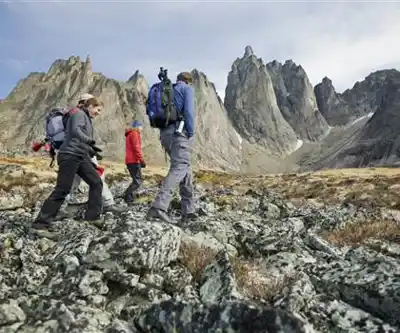
Tombstone Territorial Park is one of the most visually striking wilderness areas in the Yukon — and honestly, in all of Canada. The park sits along the Dempster Highway, which crosses the Arctic Circle, and the landscape it protects is unlike anything most hikers have encountered before. Jagged dark peaks, sweeping tundra valleys, braided rivers, and a silence that feels almost physical — this place earns its reputation.
The Landscape
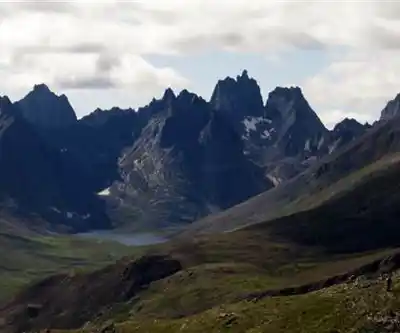
The park takes its name from Tombstone Mountain, a dramatic granite spire that dominates the skyline near the southern entrance. The terrain here is defined by the Tombstone Range, a series of sharp, dark peaks formed from ancient intrusive rock that cuts a stark contrast against the open tundra. Below the peaks, the land rolls through alpine meadows, boggy lowlands, and river flats carved by glacial meltwater over thousands of years.
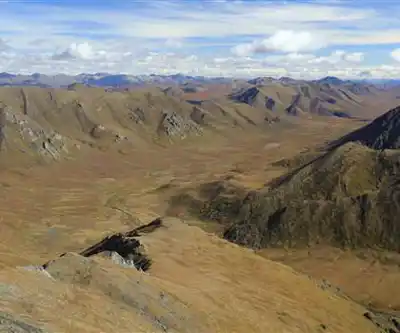
This is permafrost country. The ground beneath your feet is frozen year-round at depth, which shapes everything — the way water pools on the surface, the way vegetation grows in low, dense mats, the way the land feels spongy and alive underfoot. Polygonal ground patterns, frost boils, and pingo-like features are visible throughout the park if you know what to look for.
The park protects 2,200 km² of rare and ecologically significant wilderness where several major biogeographic regions overlap. You'll move through boreal forest at lower elevations, transition into shrub tundra, and climb into alpine terrain — sometimes all within a single day of hiking. That ecological layering is part of what makes Tombstone so compelling for naturalists and backcountry travelers alike.
Wildlife
Tombstone Territorial Park is serious wildlife habitat. The park sits within the traditional territory of the Tr'ondëk Hwëch'in First Nation and has been recognized for its exceptional biodiversity. Grizzly bears are present throughout the park — this is not a place to hike without bear awareness, proper food storage, and bear spray. Wolves, wolverines, Dall's sheep, and caribou are all part of the ecosystem here.
The park also lies along important migratory corridors. During fall migration especially, the skies and valleys can be alive with movement. Golden eagles funnel through the Tombstone Range in significant numbers during autumn, making this one of the better eagle migration observation points in the north.
Hiking and Access
The Dempster Highway provides the main access corridor into the park. The Tombstone Interpretive Centre, located near the highway, serves as the primary entry point for most visitors and is a worthwhile stop before heading into the backcountry. Staff there can provide current trail conditions, wildlife activity reports, and backcountry registration — which is strongly recommended.
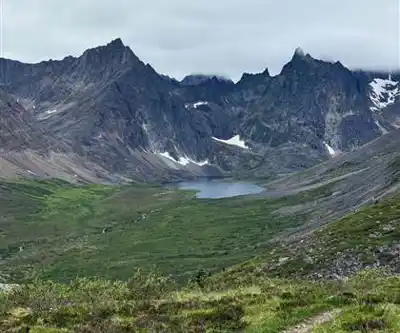
The park offers a range of hiking options, from short interpretive walks near the highway to multi-day backcountry routes that push deep into the range. Popular destinations include Grizzly Lake and Divide Lake in the alpine terrain, as well as the North Klondike River valley for multi-day trips. Many of the longer routes are not formal trails — they follow ridgelines, river valleys, and open tundra where route-finding skills and topographic map reading are essential. This is not a park where you can rely on blazes and signage once you leave the main corridor.
Both backcountry routes require solid backcountry experience and appropriate gear.
Camping
The park has a frontcountry campground near the Interpretive Centre along the Dempster Highway, with basic facilities. For backcountry camping, the park operates on a leave-no-trace ethic — there are designated backcountry camping zones, and campers are expected to practice low-impact techniques throughout. Bear canisters or approved food storage are required in the backcountry.
Season and Conditions
The hiking season at Tombstone is short. Snow can linger well into June at higher elevations, and early fall snowfall is possible by late August or September. The prime window for most visitors is July through mid-August, when the tundra is in full bloom and conditions are most stable. That said, weather in the Tombstone Range can shift fast — cold, wind, and rain are possible any day of the season, and hikers should be prepared for all of it.
Bugs — particularly mosquitoes and blackflies — are a real factor in early to mid-summer. A head net and insect-repellent clothing are not optional; they're part of the gear list.
The Dempster Highway itself is a gravel road, and driving conditions can change significantly with rain. Flat tires are common enough that carrying two spare tires is standard advice for anyone driving the Dempster. Check road conditions before heading out.
Cultural Context
Tombstone Territorial Park sits within the traditional territory of the Tr'ondëk Hwëch'in, whose connection to this land spans thousands of years. The park's management reflects a collaborative relationship with the Tr'ondëk Hwëch'in First Nation, and visitors are encouraged to approach the landscape with that context in mind. The Interpretive Centre includes programming and exhibits that speak to this history and the ongoing relationship between the First Nation and the land.
What to Know Before You Go
- Bear awareness is non-negotiable. Carry bear spray, know how to use it, and follow all food storage requirements.
- Backcountry registration is strongly recommended — let someone know your route and expected return.
- Navigation skills matter. Many routes in the park are off-trail. Bring topographic maps and a compass or GPS.
- The Dempster Highway is gravel. Two spare tires are standard advice for the drive.
- Weather changes fast. Pack layers, rain gear, and be prepared for cold even in summer.
- Bugs are intense in early summer. Head nets and insect-repellent clothing are essential.
- Stop at the Interpretive Centre for current conditions, wildlife reports, and backcountry information before heading in.
Recommended gear for this trail


Ready to go?
Everything you need to know before you goStarting Point
The tombstone territorial park is located in Yukon, Canada. The best way to get to the start of the trails is to drive to the park and then walk to the start of the trails.
When?
How much?
- Hiking shoes Essential
- → Salomon Elixir Tour Mid WP · 203.38 $
- Layered clothing Essential
- Rain jacket Essential
- Trekking poles
- → Black Diamond Trail Ergo Cork · 69.99 $
- Headlamp
- → Petzl Actik Core 625 · 103.95 $
FAQ - Frequently asked questions
Everything you need to know
25 hikes under 2 hours from Montreal
Distance, elevation, parking and season for each one. The ones we go back to ourselves.
Get the guideSimilar hikes nearby
Discover other trails you might enjoy

Hiking near Jasper
82 trails to explore ~1744 km away
We work hard to provide the most up-to-date and error-free data possible. If something seems incorrect, let us know! Your contribution helps the whole community.
Hikers' opinions