If you're the type who feels proud because you walk every day from your front door to your car, it might be time to add a bit of challenge to your adventure.
Hiking is a sport accessible to everyone, regardless of taste and physical condition.
Like any other activity you practice for the first time, the secret is to enjoy it and go at your own pace so you'll want to do it again - you'll progress without even realizing it.
Plus, you're not starting from nothing, because in theory, you've already mastered the basic movement since you were two years old.
But watch out!
If mowing your lawn is the most daring contact you've had with flora, you might find the world of nature hiking a bit disorienting.
Even though this way of moving is natural, I guarantee that walking in the forest isn't like strolling in a park. There are a couple of little things you need to think about to ensure everything goes well and that you'll want to repeat the experience.
You need to admit to yourself once and for all; the majority of your buddies and you live in a world of comfort. And you'll need to relearn how to communicate with nature to appreciate all its beauty.
I'm presenting here some tips that will allow you to get off on the right foot in this new adventure that is outdoor hiking.
1. Research and Start Early
Start by asking yourself what interests you. Do you really need to be dazzled to feel in harmony with yourself?
There's so much information available on the internet.
You can research the points of interest accessible on the site before going there.
If you want ideas on where to start, you can begin by checking if there's a picnic area, breathtaking viewpoints of the region, waterfalls, or the presence of a campground.
All these points of interest can give you a clear objective and motivate you to leave your city.
In most sites where there are developed trails, there's a reception office. This is usually the access point to the main trails. Reception staff can inform you about the duration and difficulty of routes, but also about points of interest you might encounter on your way.
Moreover, it's an additional precaution, because by registering your presence, you ensure that someone will come looking for you if you have problems!
A stop at reception will also allow you to get up-to-date information on trail conditions.
For example, even if the weather is mild, some trails may be flooded for days following heavy rains (information that's not always available on websites). It's preferable to have this information in hand to properly choose your route on departure day.
Besides weather, the time of day can also influence the choices you'll make.
The best time of day to start a hike is in the morning, especially if you're not experienced and don't have good knowledge of your interests and capabilities.
Too many beginner hikers start their hike too late and are caught off guard by darkness and cold in fall or heat in summer.
Aiming for places near your place of residence (less than an hour by car) is an excellent idea to ensure maximum flexibility in your first forest adventure.
2. Recognize Difficulty Levels and Set Realistic Goals
Once you've determined the object of your quest, ask yourself: is it achievable, realistic?
Also be aware of your physical capabilities and take time to properly understand the difficulty level of trails, and the time you have available.
It's preferable to choose trails based on your experience, physical condition and quality of your equipment. It's just logic, but when you have no experience, you might tend to minimize the challenge by saying: Well it's just walking!
To help you get a head start on this question, here's a short description of the classifications usually employed:
Multi-use or shared trail: usually developed to allow cyclists and hikers to share the route, these trails are usually wider and better adapted to families with young children.
Easy : flat, wider, open and usually few obstacles or elevation gain. Accessible to all.
Intermediate : usually rolling, may contain ascents, descents and relatively rough passages. The beginner who is relatively in good physical condition will adapt easily, if they remain attentive to where they place their foot.
Advanced or difficult : generally steep, narrow passages, presence of cliffs and slippery rock faces. To avoid or use with extreme caution for beginners.
Depending on the degree of difficulty, progression won't happen at the same pace. In general, an untrained beginner manages to cover about 2.5 km per hour on an easy trail and 2.25 km per hour if the trail contains some elevation changes. In constant ascent toward a summit, their pace will be about 2 km per hour.
For your first times, you'll therefore avoid launching onto trails of more than 5 to 8 km to do a maximum of 3 hours (this includes breaks). If you feel it's too much, there's no problem with that. Choose a distance you feel comfortable with.
It's always preferable for a beginner to stick to easy or intermediate trails and short distances, because it's difficult to evaluate the effort an ascent represents when you've never experienced one.
If you absolutely want to reach a summit, don't venture on a distance greater than 6 km, this distance must include your return. Above all, stay alert to your capabilities.
Aim for more modest summits or trails that offer less arduous elevation gain. Some summits are higher, but easier to reach due to more favorable elevation gain.
Topographic maps represent the best tool for evaluating the difficulty level of an ascent.
Consider the incline and efforts you deploy for the climb. If you have too much difficulty, don't hesitate to turn back or take more breaks. You must save strength for the return.
And contrary to what you think, it's especially during the descent that you risk underestimating the danger. It's precisely when gravity pushes you downward that you risk making a false step. The risks of injuries are higher, but especially lead to more serious consequences.
The first mistake of beginner hikers is to overestimate their physical capabilities and the risks that using inadequate equipment can incur.
Leave your pride aside and choose your route based on your capabilities and the reliability of the equipment you have available.
3. Prepare Materially
The second mistake is not being sufficiently prepared to face the unexpected.
I remind you that in the forest, you're far from everything. And since it's new for you, it's difficult to foresee what can go wrong. For this reason, I'm giving you some tips here.
Preparation is the basis of the pleasure you'll get from hiking. This especially allows you to enjoy the experience, regardless of what the route conditions have in store for you.
One of the pleasures of hiking is slowly discovering all the little gifts that each condition will bring you.
Some of my most beautiful hikes took place in conditions that would have glued most people in front of their TV.
It's for this reason that experienced hikers will rarely rely on weather to decide when to go out. They're ready for anything and know that weather conditions are also part of the adventure.
You look at the weather to get an idea of the conditions you'll have to face, this will among other things allow you to properly choose your clothing.
Basic advice for clothing: avoid jeans and cotton which don't effectively evacuate sweat. These types of fabrics also take a long time to dry.
If you're not equipped with sports clothing, favor layering. At least, you'll be able to remove or add layers of clothing based on weather or your degree of perspiration.
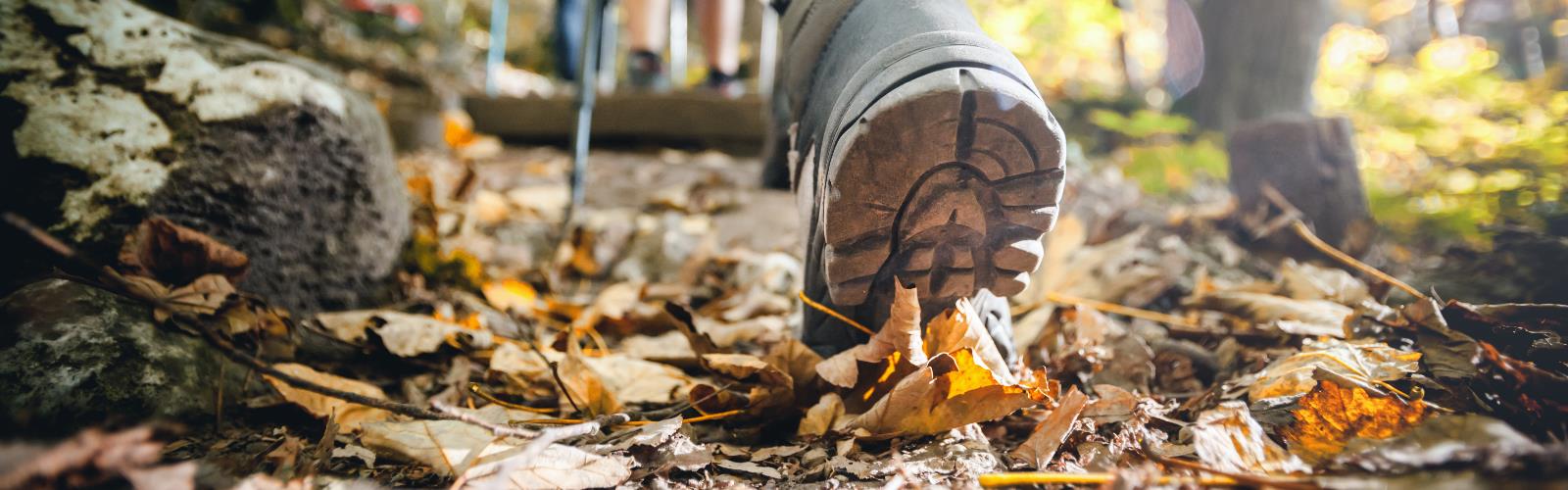
Comfortable shoes should constitute the basic element of all this equipment. Ideally, hiking shoes offer you some ankle support while having soles robust enough to support your weight and offer optimal traction on rough terrain.
If you feel comfortable with the idea of launching onto trails with your running shoes and your teenager's school bag, there's no problem with that.
Just have the intelligence to choose easy trails, without elevation gain, preferably developed, often wider, in rock dust where the ground surface is regular. Leave on a day when the weather is dry and cover shorter distances (less than two hours).
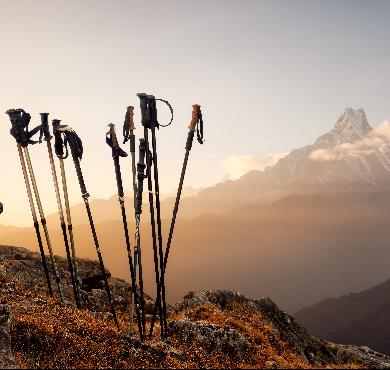
When you want to explore more, you'll be immediately convinced of the usefulness of a pair of boots, a good backpack and a pair of hiking poles. Your knees will throw themselves to the ground to thank you for this act of compassion toward them!
Besides equipment for moving, you must have a backpack where you can store some very useful things that will improve your comfort in case of trouble. A wise hiker who's about to spend most of their day in the forest should have in their backpack:
- A minimum of 1.5 liters of water for their own consumption needs;
- A topographic map of the region;
- A compass or GPS;
- A headlamp;
- A raincoat;
- A change of clothing;
- A first aid kit;
- A minimum of food;
- A knife;
- Bug spray;
- Matches or a lighter in a waterproof container;
- Toilet paper;
- Rope;
- An emergency blanket;
It might not be necessary to buy an expert kit for your first hike. At worst, you can borrow it from someone or gather some things you already have at home.
The idea of having all this equipment at your disposal is to allow you to deal with unexpected events that can occur along the way and undermine the joy you could get from this activity. If you plan to venture into the woods for more than 4 hours, I strongly suggest you refer to this list when preparing your bag for your forest stay.
4. Learn to Navigate
Often people think they get lost because they misread the map or missed a landmark, but my experience tells me rather that it's because they poorly evaluated their objectives and prepared poorly.
Getting lost is somewhat part of the risks (and even pleasures) of hiking and if you're well prepared, you can face almost all eventualities.
Yes, yes your latest iPhone has lots of gadgets that can help you, but what will you do if you no longer have network or your battery dies?
If you take time to understand how to use a GPS, it can prove to be the only navigation tool you'll need. With disconcerting precision, it can allow you to plan your route in the smallest details and even mark and find places you particularly appreciated.
If you don't have the time and money for the GPS option, don't get discouraged, because it's relatively easy to find your way in most parks, especially if you don't plan to leave the trails.
And usually, the beginner hiker has plenty to have fun with on marked trails.
It's generally quite easy to navigate on different routes. In addition to markers that indicate the direction to take, you sometimes even have the distance you have left to cover to reach your destination.
Leaving with a trail map will allow you to have more flexibility if your plans change along the way. This can be very useful if some markers disappear or maps are damaged.
The compass is mainly useful to beginners to know which way to read the map. Without elaborating on orientation, know that the top of a map indicates north and that the red end of the needle on your compass indicates the same direction.
Your compass must however be flat for it to indicate the right direction. The idea is to read your map in the same direction.
5. Go at Your Own Pace
I know I've already talked to you about it, but I insist, going at your own pace while respecting your capabilities is the best attitude to adopt to appreciate this activity.
For example, during an ascent, beginner hikers have the reflex to go too quickly without taking breaks.
A good trick to know if you're going too fast is to talk with your hiking partner. If you can sustain a conversation, it's a sign that your beautiful body is managing the situation.
Taking your time means not only adopting a walking speed that suits you, but also granting yourself the right to take regular breaks.
It's also part of the pleasures of hiking to take time to observe what surrounds you and take stock of the state of your strength.
It's the perfect moment to empty lactic acid from your limbs by doing some stretches, some cycles of conscious breathing or even taking a short nap. Micro sleep (a few minutes is enough) works miracles on body recovery!
Allowing yourself the luxury of relaxing a few minutes on a flat rock, or meditating on forest sounds is a privilege that too few people offer themselves.
Then obviously, it's the ideal moment to take a little bite.
It's preferable to stop more often and for shorter periods at a time. If you stop too long without moving, your body goes into "rest" mode and it will then be more difficult to motivate yourself to start again.
Above all, listen to your body and don't take any discomfort lightly. Certain areas like the back, knees and ankles are more at risk of suffering injuries the first times. Stretching before leaving and at the end of the activity is a good way to prevent injuries.
6. Be Accompanied
The best way to make informed decisions is to discuss them with someone else. This is even more true when you're a beginner.
The joy of a shared experience also amplifies your happiness factor.
Joining a hiking group is an excellent way to get initiated in a motivating and safe environment.
The presence of a guide will allow you to free your mind from all the little hassles. You therefore have all the leisure to concentrate on the experience of the moment.
It's a unique opportunity to learn a bit more about your own capabilities and your comfort level on different types of terrain.
There you go, you're now ready to launch onto the trails for the first time. Above all remember that the basic rule is to have fun.
If some advice I've shared in this text seems heavy or constraining to you, well tell yourself that only what you feel during your experience will allow you to measure what's necessary for you.
If you start quietly and gradually increase the duration and difficulty of your routes, you'll realize that preparation is a step that's done with pleasure. When you've connected with the benefits of this activity, you'll want by all means to prolong it.
And that day you'll be happy to have read this text that gives you a little idea of what the adventure can look like.

About the author
François Dumaine
Founder of Let's Go Play Outside
A passionate hiker, photographer and content creator, François has been hiking the trails of Quebec and Alberta since 2014. He founded Let's Go Play Outside to give you the information he wished he had before heading out.
Newsletter
Content that makes you want to go outside
Every week, a trail idea, a reflection on nature, or a tip worth the detour. Zero spam. Only the essentials.
Joined by 12,000+ outdoor enthusiasts
Read next