

Ready to explore Nepisiguit Mi'gmaq Trail? Here's everything you need to know before you go!
Discover the trail
Oh no! We don't have any photos 😢
This trail hasn't been captured yet. Be the first to share your adventure!Trail description
The Nepisiguit Mi'gmaq Trail is one of Canada's longest backcountry hiking routes, stretching 147 kilometers through the wilderness of northern New Brunswick. The trail runs from the coastal city of Bathurst inland to Mount Carleton Provincial Park, following the Nepisiguit River for much of its length. It's a serious undertaking — rated hard, with 1,500 meters of total elevation gain and an estimated completion time of around 36 hours and 45 minutes of hiking — but it rewards those who put in the effort with some of the most varied and remote terrain in the Maritimes.
The trail's name honors the Mi'gmaq people, who have traveled and lived along the Nepisiguit River for thousands of years. This wasn't just a travel corridor — it was a lifeline, a source of food, and a place of deep cultural significance. Interpretive signs placed along the route offer context about traditional Mi'gmaq land use, plant knowledge, and the spiritual relationship between the people and this river system. These markers aren't filler; they genuinely add a layer of meaning to the experience and help you understand the landscape you're moving through in a way that a purely natural history lens wouldn't.
How the Trail Changes as You Move Inland
One of the most compelling things about the Nepisiguit Mi'gmaq Trail is how dramatically the character of the route shifts over its length. Near Bathurst, the terrain is relatively gentle. Mixed forests of maple, birch, and spruce line the path, and the Nepisiguit moves slowly through a broader floodplain. It's approachable country, and the eastern sections are where day hikers and families with older kids tend to spend their time.
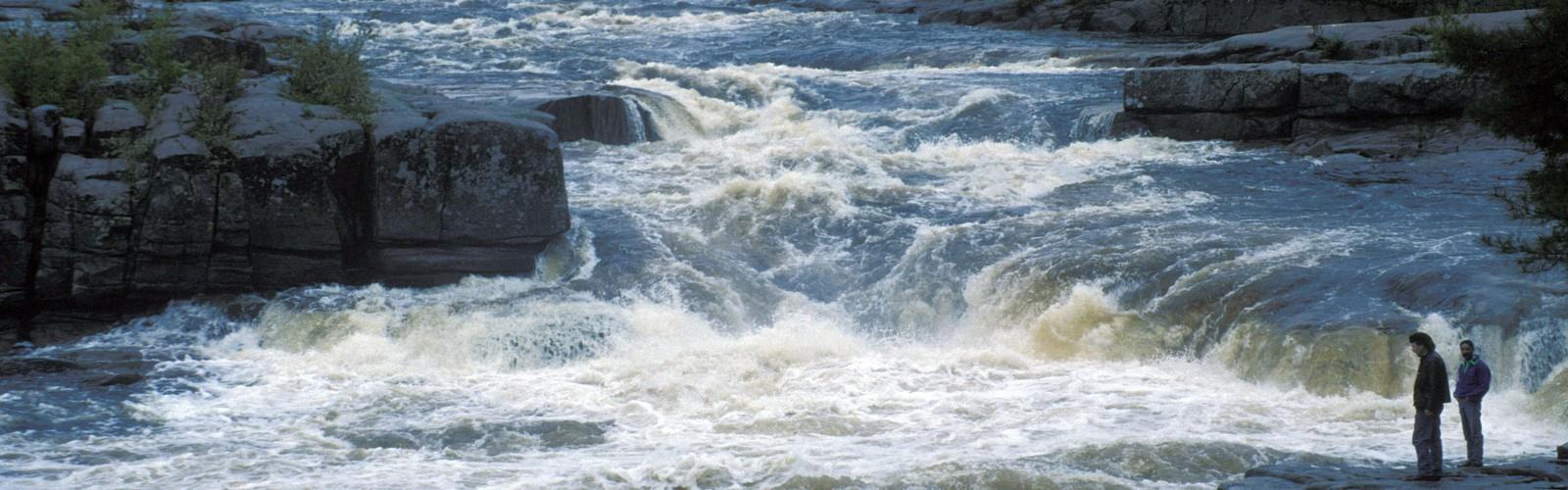
Push further west and everything changes. The forest transitions into dense boreal cover — tall conifers, darker canopy, quieter understory. The river picks up speed, breaking into rapids and cascades that you'll hear long before you see them. The trail climbs more aggressively as it approaches the Mount Carleton area, where New Brunswick's highest terrain creates real backcountry conditions. Navigation demands more attention, the gaps between road access points grow longer, and cell coverage disappears. This is where the trail earns its hard rating.
The middle sections offer a bit of both worlds — rugged enough to feel genuinely remote, but with enough river crossings, waterfalls, and open wetlands to keep the scenery interesting. These cascades range from gentle drops over moss-covered ledges to more forceful falls that carve deep pools into the bedrock. Every one of them is worth stopping at.
Wildlife and Natural Features
The diversity of ecosystems along the trail means wildlife sightings are common throughout. Moose are regularly spotted near wetlands and river edges, especially in the early morning and at dusk. Black bears are present across the backcountry sections — they're generally not a problem, but standard bear precautions apply for food storage and camp hygiene. Along the river, you have a good chance of seeing beavers, otters, and various waterfowl. Smaller animals like porcupines and red squirrels are constant trail companions in the forested sections.
The river itself is a defining feature of the entire route. It changes personality as you move upstream — broad and calm near the coast, then progressively faster, narrower, and more dramatic as the gradient increases. Several sections bring you right to the water's edge, which is useful for refilling bottles (bring reliable water treatment) and genuinely pleasant on warm days.
Doing the Trail in Sections
The 147-kilometer total distance is divided into sections, which makes the trail accessible to a wider range of hikers. You don't have to commit to the full traverse to get value out of this route. Day hikers can access individual sections from road crossings, and the eastern segments near Bathurst are the most practical for shorter outings. Multi-day backpackers tackling the full trail will want to plan resupply points around the road access locations, which also serve as emergency exit options if conditions turn.
For those attempting the complete route, the roughly 36-hour-and-45-minute moving time doesn't account for camp setup, meals, or the time you'll inevitably spend at waterfalls and river viewpoints. Most hikers spread the full traverse over several days, with the exact number depending on daily mileage goals and how much time you want to spend exploring rather than just covering ground.
What to Prepare For
The backcountry nature of the western sections means preparation matters more here than on most New Brunswick trails. Topographic maps and a compass are essential — don't rely on your phone for navigation in the remote stretches. Water is available from the river and tributaries throughout, but always treat it before drinking. Pack layers and rain gear regardless of the forecast; weather in northern New Brunswick shifts quickly, and the higher elevations near Mount Carleton are particularly exposed.
The hiking season runs from late spring through early fall. Spring conditions can be muddy and water levels run high, which complicates some crossings. Late spring and early summer bring intense black fly and mosquito pressure — insect protection isn't optional during this window, it's essential. Summer and early autumn offer the most stable conditions, with fall adding the bonus of hardwood color in the eastern sections.
Leave No Trace practices are especially important here given the trail's cultural significance and the pristine condition of much of the backcountry. Camp in designated areas where they exist, pack out everything you pack in, and treat the interpretive markers and cultural sites along the route with the respect they deserve.
The Essential Hiking Checklist
Everything you need for your next hike. Bilingual, printable, 1 page.
Get your free hiking checklistRecommended gear for this trail
As an Amazon Associate I earn from qualifying purchases.


Ready to go?
Everything you need to know before you goStarting Point
To access the hiking trails, you can start at one of several trailheads. The primary trailhead is located at Daly Point Nature Reserve, which can be accessed via 2100 Carron Drive, Bathurst, New Brunswick. Another starting point is at Pabineau Falls, accessible from Pabineau Falls Road near the community of Pabineau First Nation. Additionally, there is a trailhead at Mount Carleton Provincial Park, which can be reached by traveling to 7612 Route 385, Saint-Quentin, New Brunswick. Each location offers parking facilities for visitors.
When?
How much?
As an Amazon Associate I earn from qualifying purchases.
Affiliate links — LGPO may earn a commission at no extra cost to you.
- Hiking shoes Essential
- → Salomon Elixir Tour Mid WP · 203.38 $
- Layered clothing Essential
- Rain jacket Essential
- Trekking poles
- → Black Diamond Trail Ergo Cork · 69.99 $
- Headlamp
- → Petzl Actik Core 625 · 103.95 $
FAQ - Frequently asked questions
Everything you need to knowSimilar hikes nearby
Discover other trails you might enjoy
Hiking near Moncton
14 trails to explore ~184 km away
We work hard to provide the most up-to-date and error-free data possible. If something seems incorrect, let us know! Your contribution helps the whole community.
Hikers' opinions
Be the first to review!
No hiker has shared their experience yet. Share your impressions and help other hikers!