

Ready to explore Pipestone National Monument? Here's everything you need to know before you go!
Discover the trail
Oh no! We don't have any photos 😢
This trail hasn't been captured yet. Be the first to share your adventure!Trail description
Pipestone National Monument is one of those places that stops you in your tracks — not because of dramatic elevation changes or technical terrain, but because of the weight of what the land carries. Located in southwestern Minnesota, this federally protected site has been a sacred gathering place for Indigenous peoples for centuries, and that history is present in every step you take here.
What Makes This Place Different
The monument protects a rare deposit of catlinite, a soft red stone that Native American tribes have quarried here for generations to carve ceremonial pipes. The quarrying tradition continues today — enrolled members of federally recognized tribes have the legal right to quarry catlinite within the monument, making this an actively living cultural site, not just a preserved relic. Walking through here, you may see people at work at the quarry faces. That's not a reenactment. It's a continuation of something that has never stopped.
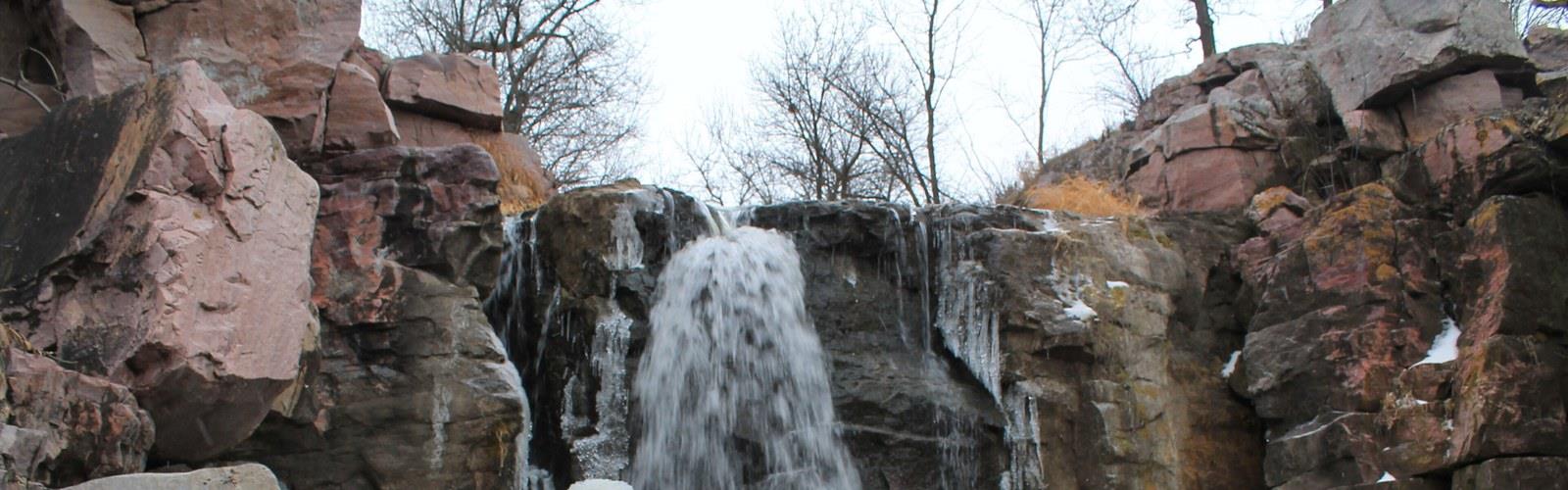
The landscape itself is striking in a quiet, open way. Prairie stretches out in every direction, punctuated by exposed Sioux quartzite outcroppings — a pinkish-red rock that forms ledges, walls, and dramatic formations along the trail corridor. Pipestone Creek runs through the site, and the combination of moving water, native grassland, and ancient stone gives the place a character that's hard to find elsewhere in the Midwest.
The Trail System
The main hiking route at Pipestone National Monument is the Circle Trail, a loop that takes you past the most significant natural and cultural features of the monument. It's a manageable walk suitable for most visitors, winding past the active quarries, along Pipestone Creek, and by several notable landmarks.
Along the way, you'll pass Winnewissa Falls, a waterfall that drops over the quartzite ledge — one of the more photogenic spots in the monument and a natural anchor point on the trail. The falls are modest in size but genuinely beautiful, especially when the creek is running well. The exposed quartzite formations throughout the loop are worth slowing down for. The rock has a reddish-pink hue that shifts with the light, and the contrast against the open prairie sky is something you don't forget easily.
The trail also passes the Oracle, a natural rock formation with cultural significance, and offers views of the open quarry areas where you can observe the catlinite layers up close. Interpretive signage throughout the loop provides context without overwhelming the experience.
The Visitor Center
Before or after your hike, the Pipestone Indian Shrine Association Cultural Center — located within the monument's visitor facilities — is worth your time. Native American artisans demonstrate pipe carving and sell handcrafted work. This is a direct, meaningful way to support the Indigenous community connected to this land, and the craftsmanship on display is exceptional. The National Park Service visitor center also provides exhibits on the geology, history, and cultural significance of the site.
Terrain and What to Expect Underfoot
The terrain at Pipestone National Monument is gentle. The land is largely flat to slightly rolling, characteristic of the southwestern Minnesota prairie. The trail surface varies — you'll walk on maintained paths, some boardwalk sections near the creek and falls, and areas where the quartzite rock itself becomes the ground beneath your feet. There are no significant climbs or technical sections. The challenge here, if there is one, is paying attention — to the details of the rock, the sounds of the creek, the openness of the sky.
Wear comfortable walking shoes. The quartzite can be uneven in spots, but nothing that requires hiking boots unless you simply prefer them. In wet conditions, some sections near the creek can be slippery, so tread carefully around the falls area after rain.
Wildlife and Natural Environment
The native tallgrass prairie surrounding the trail supports a variety of grassland birds, and the creek corridor attracts additional species. The prairie plantings within the monument include native wildflowers that bloom through the warmer months, adding color to the open landscape. The quartzite outcroppings create microhabitats that support mosses, lichens, and small plant communities that you won't find in the surrounding agricultural landscape.
Practical Information
- Entrance fee: Pipestone National Monument charges an entrance fee. Check the National Park Service website for current rates, as fees are subject to change. America the Beautiful passes are accepted.
- Visitor center hours: The visitor center operates on a seasonal schedule. Hours are typically reduced in winter. Confirm current hours before your visit.
- Dogs: Leashed pets are permitted on the Circle Trail but are not allowed inside the visitor center or cultural center buildings.
- Accessibility: Portions of the trail and the visitor center are accessible. Contact the monument directly for specific accessibility details.
- Quarrying area: The active quarry areas are reserved exclusively for enrolled tribal members. Visitors should stay on the designated trail and respect these spaces.
- Photography: Photography is welcome throughout the monument. Be respectful if you encounter tribal members at work at the quarries — ask before photographing people.
- Cell service: Coverage can be limited in this part of southwestern Minnesota. Download offline maps if needed before you arrive.
Getting There
Pipestone National Monument is located in the city of Pipestone in southwestern Minnesota. The monument is well-signed from the main roads into town. Parking is available at the visitor center. The site is a reasonable day trip from Sioux Falls, South Dakota, and is accessible from several directions via US Highway 75 and Minnesota State Highway 30.
A Note on Respect
This is a place that asks something of its visitors beyond just showing up. The land at Pipestone National Monument is sacred to many Native American nations, and the quarrying tradition here is ongoing and deeply meaningful. Walk the trail with that awareness. Read the interpretive signs. Spend time at the cultural center. Leave the catlinite and quartzite exactly where you find it — collecting any rock or material from the monument is prohibited and, more importantly, it matters here in a way that goes beyond a regulation.
Pipestone National Monument is a genuinely rare kind of place — a site where geology, ecology, and living Indigenous culture intersect in a way that's protected but not frozen in time, and that combination makes it worth the drive to this quiet corner of Minnesota.
The Essential Hiking Checklist
Everything you need for your next hike. Bilingual, printable, 1 page.
Get your free hiking checklistRecommended gear for this trail
As an Amazon Associate I earn from qualifying purchases.


Ready to go?
Everything you need to know before you goWhen?
How much?
As an Amazon Associate I earn from qualifying purchases.
Affiliate links — LGPO may earn a commission at no extra cost to you.
- Hiking shoes Essential
- → Salomon Elixir Tour Mid WP · 203.38 $
- Layered clothing Essential
- Rain jacket Essential
- Trekking poles
- → Black Diamond Trail Ergo Cork · 69.99 $
- Headlamp
- → Petzl Actik Core 625 · 103.95 $
FAQ - Frequently asked questions
Everything you need to knowHiking near Winnipeg
17 trails to explore ~657 km away
We work hard to provide the most up-to-date and error-free data possible. If something seems incorrect, let us know! Your contribution helps the whole community.
Hikers' opinions
Be the first to review!
No hiker has shared their experience yet. Share your impressions and help other hikers!