
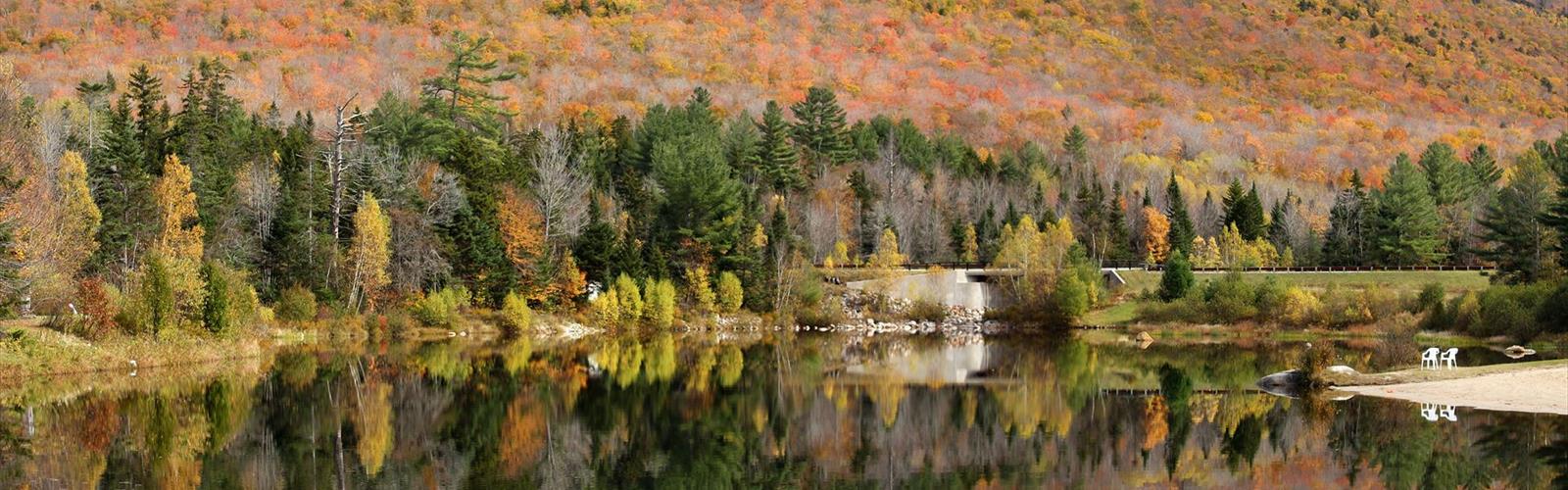

Ready to explore Flat Mountain Pond Shelter? Here's everything you need to know before you go!
Discover the trail
Available trails
| TrailTrails | Dist.Distance | GainElevation | TimeDuration | Difficulty | GPX |
|---|---|---|---|---|---|
|
|
16.78 km | — | 4h | GPX |
GPX track: © OpenStreetMap contributors — ODbL 1.0
Trail description
The Flat Mountain Pond Shelter sits quietly in New Hampshire's White Mountain National Forest, offering one of the region's most peaceful backcountry experiences. This rustic shelter overlooks the pristine waters of Flat Mountain Pond, where the surrounding forest creates a natural amphitheater of towering pines and hardwoods that reflect perfectly in the still water on calm days.
What sets this destination apart from busier White Mountain locations is its sense of genuine remoteness. The pond stretches out like a hidden mirror, surrounded by gentle slopes rather than the dramatic peaks that dominate much of the region. This creates an intimate wilderness experience where the scale feels more human and approachable, yet you're still deep enough in the backcountry to feel completely disconnected from civilization.
Getting There
Two main trails provide access to the shelter, each offering a different character of hiking experience. The Flat Mountain Pond Trail serves as the primary route, winding through dense mixed forest where you'll cross several small streams on wooden bridges. The trail follows old logging roads for portions of the journey, creating wider, more gradual sections that alternate with narrower single-track segments.
The Bennett Street Trail offers an alternative approach, connecting with the pond trail system to create loop possibilities for those wanting to vary their route. Both trails are moderately challenging, featuring steady climbs through typical New Hampshire terrain of rocky sections, root-crossed paths, and occasional muddy spots that persist well into summer.
Expect to encounter the characteristic White Mountain mix of terrain: granite ledges that require careful footing, especially when wet, and forest floor sections carpeted with pine needles that provide softer walking. The trails wind alongside babbling brooks for much of the journey, with the sound of moving water serving as a constant companion. During spring snowmelt and after heavy rains, these streams swell considerably, adding to the auditory landscape of your hike.
The Shelter Experience
The shelter itself embodies the classic New Hampshire backcountry style: a three-sided log structure with a slanted roof that opens toward the pond. Basic wooden sleeping platforms can accommodate several hikers, though the shelter operates on a first-come, first-served basis, so arrival time can determine your sleeping arrangements. The open design means you'll fall asleep to the sounds of the forest and wake to views of the pond through the trees.
A fire ring sits in front of the shelter, positioned to take advantage of both the warmth and the view. Evening hours here take on a special quality as the pond surface becomes mirror-still and the surrounding forest settles into twilight quiet. The lack of electric lights means stars appear with remarkable clarity on clear nights, and the Milky Way becomes visible once your eyes adjust to the darkness.
Since this is a backcountry shelter, you'll need to bring all your own supplies, including water purification methods, food, sleeping gear, and cooking equipment. The rustic nature means no amenities beyond the basic structure and fire ring, so plan accordingly for a true wilderness camping experience.
The Pond and Wildlife
Flat Mountain Pond serves as the area's centerpiece, offering opportunities that extend well beyond just admiring the view. The clear water supports fishing, though you'll want to check current regulations and licensing requirements. The pond's relatively shallow depth and protected location create ideal conditions for wildlife viewing, particularly during early morning and evening hours.
Moose frequent the area, often appearing at the pond's edge during dawn and dusk to drink and feed on aquatic vegetation. Their massive forms create unforgettable silhouettes against the water, especially during the golden light of sunrise. The patient observer might witness these giants wading into the pond, submerging their heads completely to reach preferred plants on the bottom.
Loons nest on the pond during summer months, their distinctive calls echoing across the water in the early morning hours. The haunting sound carries remarkably well in the still air, often serving as a natural alarm clock for shelter occupants. Beavers also maintain an active presence, with their lodge visible from certain vantage points around the pond's perimeter.
The surrounding forest hosts typical New Hampshire wildlife including black bears, white-tailed deer, and various smaller mammals. Proper food storage becomes essential, both for safety and to avoid attracting unwanted nighttime visitors to the shelter area.
Photography and Seasonal Considerations
The pond's orientation and surrounding topography create excellent conditions for photography throughout the day. Morning light filters through the eastern forest, creating dramatic rays that pierce the mist often rising from the water's surface. The reflection opportunities change constantly with wind conditions, offering everything from perfect mirror images to subtle ripple patterns.
Each season transforms the area's character completely. Spring brings rushing water in all the feeder streams and the fresh green of emerging leaves. Summer offers the fullest wildlife activity and warmest water temperatures. Fall creates spectacular foliage reflections in the pond, with the surrounding maples and birches providing brilliant reds and yellows. Winter access requires snowshoes or skis, but rewards visitors with a crystalline landscape of snow-laden evergreens and frozen pond surfaces.
Planning Your Visit
The moderate trail difficulty makes this destination accessible to hikers with basic experience, though the backcountry nature requires solid preparation and self-sufficiency. The elevation gain of 305 meters spreads out over the trail distance, creating manageable grades rather than steep, sustained climbs. Most hikers should plan for 6 to 8 hours total, allowing time for both the journey and enjoying the destination.
Leave No Trace principles become particularly important in this pristine setting. Pack out all trash, use established fire rings only, and camp only in designated areas. The shelter's continued availability depends on visitors maintaining the area's natural condition for future adventurers.
The Essential Hiking Checklist
Everything you need for your next hike. Bilingual, printable, 1 page.
Get your free hiking checklistRecommended gear for this trail
As an Amazon Associate I earn from qualifying purchases.


Ready to go?
Everything you need to know before you goStarting Point
The easiest way to get to the start of the trails at the flat mountain pond shelter is to drive to the end of Flat Mountain Pond Road in Pittsburg, NH. There is a small parking lot at the end of the road.
When?
How much?
As an Amazon Associate I earn from qualifying purchases.
Affiliate links — LGPO may earn a commission at no extra cost to you.
- Hiking shoes Essential
- → Salomon Elixir Tour Mid WP · 203.38 $
- Layered clothing Essential
- Rain jacket Essential
- Trekking poles
- → Black Diamond Trail Ergo Cork · 69.99 $
- Headlamp
- → Petzl Actik Core 625 · 103.95 $
FAQ - Frequently asked questions
Everything you need to knowSimilar hikes nearby
Discover other trails you might enjoy

Crawford
White Mountains
Presidential Range Rail Trail
White Mountains
Welch-Dickey Trailhead
White Mountains
Sabbaday Falls
White Mountains
Swift River
White Mountains
Mt Bond
White Mountains
Hiking near North Conway
0 trails to explore ~31 km away
We work hard to provide the most up-to-date and error-free data possible. If something seems incorrect, let us know! Your contribution helps the whole community.
Hikers' opinions
Be the first to review!
No hiker has shared their experience yet. Share your impressions and help other hikers!