
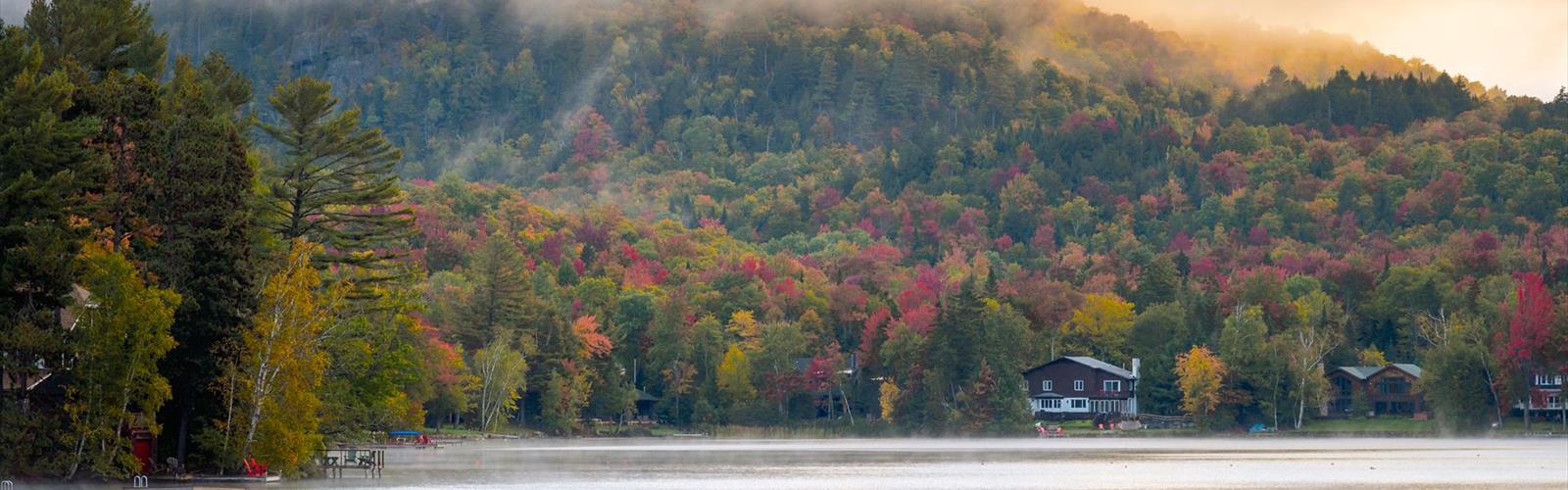

Ready to explore Moose Mountain, New York? Here's everything you need to know before you go!
Discover the trail

Photos: Shiva Shenoy from Flower Mound, United States — CC BY 2.0 (Wikimedia Commons)
Trail description
Moose Mountain sits in the heart of the Adirondacks, offering one of those hikes that earns its reputation through honest effort and genuine reward. At 6.4 km with 1,188 meters of elevation gain, this is a hard day out—the kind that leaves your legs tired and your head clear. Plan for around 3 hours and 35 minutes of moving time, though most hikers will want to add extra time at the summit.
The trail starts in dense mixed forest typical of the Adirondack interior. Hemlocks and hardwoods close in overhead, filtering the light and keeping things cool even on warm days. The forest floor is active—mosses, ferns, and the kind of undergrowth that signals a healthy, undisturbed ecosystem. Early on, the grade is manageable, which gives you a chance to find your footing before the trail gets serious.
The Climb
The elevation gain is where Moose Mountain earns its hard rating. Spread over 6.4 km, 1,188 meters of climbing means this trail doesn't let up for long. There are sections where the grade eases and you get a moment to breathe, but expect sustained uphill work for most of the ascent. The trail is well-marked and maintained, so route-finding isn't the challenge here—it's simply the physical demand of gaining that much elevation in a relatively short distance.
As you climb, the forest composition shifts. The lower mixed woods gradually give way to species better adapted to higher elevations and thinner soils. These transitions are subtle but noticeable, and they mark your progress up the mountain as clearly as any trail sign.
Wildlife
The mountain lives up to its name. Moose do inhabit these forests, and while a sighting is never guaranteed, early morning starts give you the best odds—particularly near any wet areas or stream crossings along the route. White-tailed deer are more commonly seen, and the bird life throughout the Adirondack forest is consistently active. Smaller mammals—red squirrels, chipmunks, the occasional snowshoe hare—are regular trail companions.
The biodiversity here reflects the broader health of the Adirondack Park ecosystem. This is a large, protected wilderness, and Moose Mountain sits within it rather than on its edge, which means the wildlife encounters feel genuine rather than incidental.
The Summit
The payoff at the top is real. The summit of Moose Mountain opens up views across the surrounding Adirondack peaks and valleys—the kind of panorama that makes the climb feel worth every meter of elevation gain. On a clear day, the scale of the Adirondack Park becomes apparent in a way that's hard to grasp from the valley floor. Multiple mountain ranges stack up toward the horizon, and the forest stretches unbroken in every direction.
The summit area has enough open space to sit down, eat something, and actually take in the view rather than just photograph it and move on. That's worth factoring into your time estimate—most people don't rush off the top of Moose Mountain.
Seasonal Notes
Summer hiking here means full forest cover, comfortable temperatures in the lower sections, and noticeably cooler air at the summit. Afternoon thunderstorms are a real consideration during July and August—start early and keep an eye on the sky as you approach the top. Fall is exceptional in the Adirondacks, and Moose Mountain is no exception. The hardwood canopy turns in late September and into October, and the summit views during peak foliage are among the best the region offers. Spring hiking is possible but expect muddy, soft trail conditions through May.
What to Bring
Given the elevation gain and hard difficulty rating, footwear matters. Stiff-soled hiking boots with good ankle support are the right call—trail runners work for experienced hikers who know what they're getting into, but this isn't the place to test out light footwear for the first time. Carry more water than you think you need; the sustained climbing will push your consumption higher than a flatter trail of the same distance.
Layers are essential. The summit sits significantly higher than the trailhead, and temperature differences between the two can be substantial, especially in shoulder seasons. A wind layer and a mid-layer take up minimal space and make a real difference if conditions shift while you're on top.
Standard day hiking kit applies: a small first aid kit, snacks with real caloric density, a trail map, and a fully charged phone. No specialized gear is required—Moose Mountain is a demanding hike, but it's not a technical one.
Getting the Most Out of the Day
Moose Mountain connects to the broader Adirondack trail network, so hikers looking to extend their time in the area have options. The region around the mountain offers additional routes and access points worth exploring if you're planning more than a single-day visit. The Adirondacks reward hikers who take time to move through the area rather than treating individual peaks as isolated objectives—Moose Mountain fits naturally into that kind of multi-day approach.
An early start is always the right call here: you'll have the trail to yourself in the morning, the wildlife is more active, and you'll be well off the summit before any afternoon weather develops.
The Essential Hiking Checklist
Everything you need for your next hike. Bilingual, printable, 1 page.
Get your free hiking checklistRecommended gear for this trail
As an Amazon Associate I earn from qualifying purchases.


Ready to go?
Everything you need to know before you goStarting Point
To access the hiking trails, you can start at the primary trailhead located at the end of Northwoods Club Road. From Interstate 87 (I-87), take Exit 29 and head west on Blue Ridge Road for about 2 miles. Turn right onto Northwoods Club Road and continue for approximately 7 miles until you reach the parking area near the trailhead. There are no alternative trailheads for this location.
When?
How much?
As an Amazon Associate I earn from qualifying purchases.
Affiliate links — LGPO may earn a commission at no extra cost to you.
- Hiking shoes Essential
- → Salomon Elixir Tour Mid WP · 203.38 $
- Layered clothing Essential
- Rain jacket Essential
- Trekking poles
- → Black Diamond Trail Ergo Cork · 69.99 $
- Headlamp
- → Petzl Actik Core 625 · 103.95 $
FAQ - Frequently asked questions
Everything you need to knowSimilar hikes nearby
Discover other trails you might enjoy

Algonquin Peak, New York
Adirondacks

Big Slide Mountain, New York
Adirondacks

Boundary Peak, New York
Adirondacks
Crane Mountain
Adirondacks
Avalanche Pass
Adirondacks
Ampersand Mountain, New York
Adirondacks
Hiking near Lake Placid
0 trails to explore ~8 km away
We work hard to provide the most up-to-date and error-free data possible. If something seems incorrect, let us know! Your contribution helps the whole community.
Hikers' opinions
Be the first to review!
No hiker has shared their experience yet. Share your impressions and help other hikers!