


Ready to explore Crawford Lake Conservation Area (Reservations Required)? Here's everything you need to know before you go!
Discover the trail
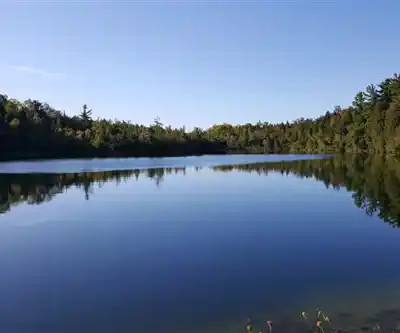
Trail description
Crawford Lake Conservation Area stands out as one of the most genuinely distinctive hiking destinations in the Halton region — and honestly, in all of southern Ontario. Located near Campbellville in Milton, it protects a scientifically rare lake while offering 19 kilometres of well-maintained trails that connect directly to the Bruce Trail system. The reservation requirement keeps visitor numbers manageable, which means the experience here feels more personal and less crowded than many comparable conservation areas in the Greater Toronto Area.
What makes Crawford Lake different from a typical trail destination isn't just the scenery — it's the layering of natural science, Indigenous history, and settler heritage into a single, walkable landscape. You're not just hiking through a pretty forest; you're moving through a place that has been continuously studied, interpreted, and carefully protected for decades.
Crawford Lake Itself
The lake is the anchor of the whole experience, and it earns that role. Crawford Lake is a meromictic lake — a rare type where the deep water layers never mix with the surface layers, even seasonally. Most lakes in Ontario turn over twice a year as water temperatures shift, but Crawford Lake's unusual depth-to-surface-area ratio creates permanent stratification. The result is a dark, still body of water that looks almost otherworldly, especially on overcast days.
This stratification isn't just visually striking — it's scientifically invaluable. Because the deep water never mixes, organic material settles undisturbed into the sediment year after year, building up an extraordinarily detailed record of the surrounding environment. Pollen analysis of sediment cores has allowed researchers to reconstruct centuries of ecological and human history. Geochemical studies have documented roughly 150 years of air pollution trends in southern Ontario, making Crawford Lake a living archive of environmental change. The lake holds designations as a regional Environmentally Sensitive Area, an Ontario Area of Natural and Scientific Interest, and part of the Niagara Escarpment World Biosphere Reserve.
Trail Network and Terrain
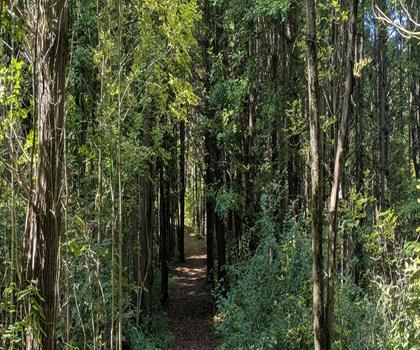
The 19-kilometre trail system covers a range of terrain that reflects the Niagara Escarpment's geological character. Mixed hardwood forest, rocky outcrops, wetland edges, and root-covered escarpment paths all feature across the network, giving the trails a varied feel even within a single outing.
The main lake loop is the most accessible route — relatively flat with gentle rolling sections, it circles Crawford Lake's perimeter and includes interpretive signage that explains the lake's scientific significance. It's a good fit for families or anyone who wants a shorter, lower-effort walk with a strong payoff in terms of scenery and context.
The trails connecting to the Bruce Trail system push into more demanding territory. These sections climb onto the escarpment proper, with steeper grades, exposed rock, and rooted terrain that requires more attention underfoot. The elevation gain across the trail network reaches approximately 50 metres, which is modest overall but concentrated in specific sections. The reward for the extra effort is elevated views across the surrounding landscape and a closer look at the geological features that define this part of Ontario.
The Reconstructed Iroquoian Village
One of the most compelling stops in the conservation area is the reconstructed fifteenth-century Iroquoian village. This isn't a generic heritage display — it emerged directly from the scientific discoveries made possible by Crawford Lake's sediment record. Pollen analysis revealed evidence of Indigenous agricultural activity and settlement patterns dating back several centuries, which led archaeologists to locate and excavate the original Wendat village site nearby.
The reconstruction is based on that archaeological research and operates seasonally, offering interpretive programs that cover traditional building methods, agricultural practices, and daily life. The combination of hard scientific evidence and on-the-ground cultural interpretation gives this site a credibility and depth that's rare in heritage programming. It's worth timing your visit to catch one of the scheduled programs if you can.
Historical Layers
The conservation area also carries traces of its more recent past. The lake takes its name from the Crawford family, early European settlers who built their homestead on this land. Their house is long gone — destroyed by fire — but the concrete front porch still stands as a quiet remnant of that era. Historical photographs document the family's life here and their cedar tree farming operation on the opposite shore of the lake, adding another layer to a site that already holds centuries of human presence.
Seasonal Use
Crawford Lake Conservation Area is open year-round, and the trail network shifts function with the seasons. In warmer months, the 19 kilometres of trails serve hikers across a range of skill levels, with the lake loop and escarpment connections offering different experiences within the same visit. The interpretive village and its programming run during the main visitor season.
In winter, the same trail network transitions to cross-country skiing and snowshoeing. Trails are groomed and maintained for snow use, and the winter version of the lake — still and dark beneath a snow-covered forest — has its own distinct atmosphere worth experiencing.
Practical Notes
Advance reservations are required for all visits to Crawford Lake Conservation Area. This is Conservation Halton's approach to managing visitor impact on a site with genuinely sensitive natural and cultural resources — the meromictic lake ecosystem and the reconstructed village both benefit from controlled access. Book ahead before making the trip.
The conservation area's location near Campbellville puts it within reasonable reach of the Greater Toronto Area while still feeling removed from urban surroundings. For hikers who want to extend their day, the Bruce Trail connection opens up additional escarpment terrain beyond the conservation area's boundaries, linking Crawford Lake into the broader trail network that runs across southern Ontario.
Recommended gear for this trail
As an Amazon Associate I earn from qualifying purchases.


Ready to go?
Everything you need to know before you goStarting Point
The Crawford Lake Conservation Area is located in Milton, Ontario. To get to the start of the trails, take Highway 401 to Highway 25 (exit 407). Go north on Highway 25 to Steeles Avenue. Turn left on Steeles Avenue and go to the end. Turn right on Conservation Road and go to the end. The entrance to the conservation area is on the right.
The Crawford Lake Conservation Area is located in Milton, Ontario. To get to the start of the trails, take Highway 401 to Highway 25 (exit 407). Go north on Highway 25 to Ninth Line. Turn left on Ninth Line and go to Conservation Road. Turn right on Conservation Road and go to the end of the road.
When?
How much?
As an Amazon Associate I earn from qualifying purchases.
Affiliate links — LGPO may earn a commission at no extra cost to you.
- Hiking shoes Essential
- → Salomon Elixir Tour Mid WP · 203.38 $
- Layered clothing Essential
- Rain jacket Essential
- Trekking poles
- → Black Diamond Trail Ergo Cork · 69.99 $
- Headlamp
- → Petzl Actik Core 625 · 103.95 $
FAQ - Frequently asked questions
Everything you need to know
25 hikes under 2 hours from Montreal
Distance, elevation, parking and season for each one. The ones we go back to ourselves.
Get the guideSimilar hikes nearby
Discover other trails you might enjoy
Nassagaweya Canyon
Hamilton, Halton and Brant
Paletta Lakefront Park
Hamilton, Halton and Brant
Dundas Valley Conservation Area
Hamilton, Halton and Brant

Royal Botanical Gardens - Hendrie Valley Sanctuary (Cherry Hill Gate Trail)
Hamilton, Halton and Brant
Rattlesnake Point Conservation Area (Reservations Required)
Hamilton, Halton and Brant
Dundas Driving Park
Hamilton, Halton and Brant
Hiking near Hamilton
162 trails to explore ~25 km away
We work hard to provide the most up-to-date and error-free data possible. If something seems incorrect, let us know! Your contribution helps the whole community.
Hikers' opinions
Be the first to review!
No hiker has shared their experience yet. Share your impressions and help other hikers!