

Ready to explore East Sister, Nevada? Here's everything you need to know before you go!
Discover the trail
Oh no! We don't have any photos 😢
This trail hasn't been captured yet. Be the first to share your adventure!Trail description
East Sister is a demanding peak in Nevada's Reno-Tahoe region, sitting at the intersection of Great Basin desert and Sierra Nevada alpine terrain. With 3,171 meters of elevation gain over 8 kilometers, this is a serious mountain objective — not a casual day hike. Plan for around 6.5 hours on the trail, and come prepared for everything the Nevada high country can throw at you.
The Climb
The route starts in classic Nevada high desert, where the ground is rocky, the air is dry, and the landscape has that open, exposed quality that defines the Great Basin. Early on, you're moving through terrain shaped by ancient volcanic and tectonic activity — the rock underfoot tells that story clearly if you're paying attention. The geology shifts as you gain elevation, and the character of the hike changes with it.
The elevation gain here is relentless. This isn't a trail that gives you long flat stretches to recover — the ascent is sustained, and the steeper sections demand real effort. Good pacing matters from the first kilometer. Hikers who push too hard early will feel it long before the summit. Between the harder pitches, the terrain occasionally opens into broader, more gradual sections where you can catch your breath and take in the expanding views around you.
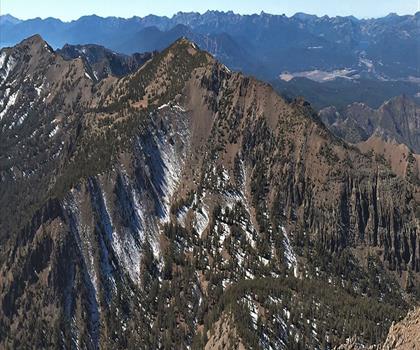
As you climb higher, the landscape becomes increasingly alpine. The vegetation thins, the rock dominates, and the ridgelines become more exposed. Views across the basin and range topography open up progressively — by the time you're in the upper sections of the route, you're looking out over a landscape that stretches far into the distance in multiple directions. Nevada's backcountry has a particular kind of scale that's hard to appreciate until you're standing in the middle of it at elevation.
Terrain and Conditions
The trail involves rocky outcrops, exposed ridgelines, and sections where route-finding requires attention. Footwear with solid ankle support and reliable traction on loose rock is not optional here — it's necessary. The upper mountain is exposed, which means wind can be a real factor, and weather at elevation can shift faster than forecasts at lower elevations suggest.
Nevada's high country is also genuinely dry. There are no reliable water sources on the mountain, so you need to carry everything you'll need for the full 6.5 hours. In summer, the combination of high UV intensity, reflected light off rock surfaces, and dry air means your water consumption will be higher than you might expect. Sun protection — sunscreen, sunglasses, a hat — is essential, not optional.
Layered clothing is the right approach regardless of what the weather looks like when you start. Temperatures at the summit can be significantly colder than at the trailhead, and afternoon thunderstorms are a real possibility during summer months in the Nevada mountains. Starting early gives you the best chance of being off the exposed upper terrain before afternoon weather develops.
Wildlife and Flora
The elevation range on East Sister creates distinct zones of plant life, and the transition between them is one of the more interesting aspects of the hike. Desert-adapted species give way to hardier mountain flora as you gain altitude, and the shift is noticeable. Birds of prey are commonly spotted using the thermals above the ridgelines. The broader ecosystem here reflects the Great Basin's characteristic adaptations — species that have evolved to handle temperature extremes, intense sun, and limited water.
Spring can bring wildflower displays in the lower and mid-elevation sections, though timing depends heavily on snowpack and the pace of the season. When conditions are right, the color contrast against the rocky terrain is striking.
Solitude and Night Skies
East Sister's remote setting means you're unlikely to encounter crowds on the trail. The distance from major population centers translates directly into quiet — the kind of quiet where you notice wind direction and bird calls rather than other hikers. For people who value that kind of experience, this mountain delivers it consistently.
The same remoteness that keeps the trail uncrowded also means genuinely dark skies. If you're camping in the area, the night sky above Nevada's high country is exceptional — the Milky Way is clearly visible, and the absence of light pollution makes for some of the best stargazing in the region.
Who This Hike Is For
East Sister is rated hard, and that rating is accurate. The combination of distance, sustained elevation gain, exposed terrain, and Nevada's demanding climate makes this a hike for people who are already comfortable in the mountains and have the fitness to back it up. If you're building toward bigger objectives in the Reno-Tahoe region, East Sister is the kind of route that will tell you honestly where you stand.
Come with solid footwear, more water than you think you need, sun protection, layers, and a realistic sense of your own pace — and East Sister will give you one of the more rewarding days Nevada's high country has to offer.
The Essential Hiking Checklist
Everything you need for your next hike. Bilingual, printable, 1 page.
Get your free hiking checklistRecommended gear for this trail
As an Amazon Associate I earn from qualifying purchases.


Ready to go?
Everything you need to know before you goStarting Point
To access the hiking trails, you can start at the primary trailhead located at the end of East Sister Road. If you're driving, take Highway 50 and turn onto East Sister Road, following it until you reach the designated parking area. There are no alternative trailheads for this location.
When?
How much?
As an Amazon Associate I earn from qualifying purchases.
Affiliate links — LGPO may earn a commission at no extra cost to you.
- Hiking shoes Essential
- → Salomon Elixir Tour Mid WP · 203.38 $
- Layered clothing Essential
- Rain jacket Essential
- Trekking poles
- → Black Diamond Trail Ergo Cork · 69.99 $
- Headlamp
- → Petzl Actik Core 625 · 103.95 $
FAQ - Frequently asked questions
Everything you need to knowSimilar hikes nearby
Discover other trails you might enjoy
Hiking near Victoria
93 trails to explore ~1148 km away
We work hard to provide the most up-to-date and error-free data possible. If something seems incorrect, let us know! Your contribution helps the whole community.
Hikers' opinions
Be the first to review!
No hiker has shared their experience yet. Share your impressions and help other hikers!