When I started exploring winter activities in Quebec, I never thought I'd one day be able to survive a fall through ice in 7 precise steps. Yet, after spending entire winters on the frozen lakes of the Laurentides and experiencing some memorable scares, I realized I needed to master these survival techniques. Because let's be honest: when you practice ice fishing, snowshoeing on lakes, or even simple ice walking, zero risk doesn't exist.
In the next few minutes, you'll discover the 7 crucial steps that can literally save your life if you fall through ice. These techniques, I learned them the hard way and tested them (fortunately not all in real situations!). You'll also understand how to prevent these situations and what to do to help someone else in this predicament.
Why does ice give way and how to recognize dangerous zones?
Before talking about survival, you need to understand why we end up in this situation. Ice isn't like concrete - it lives, it moves, it changes according to a ton of factors I've learned to observe over the years.
The most treacherous zones are often where you least expect them. River mouths remain dangerous even in extreme cold because flowing water keeps the ice thin. I've seen experienced guys get caught near waterfalls and rapids like at Canyon Sainte-Anne because they underestimated the current's effect.
The visual signs that should make you turn back:
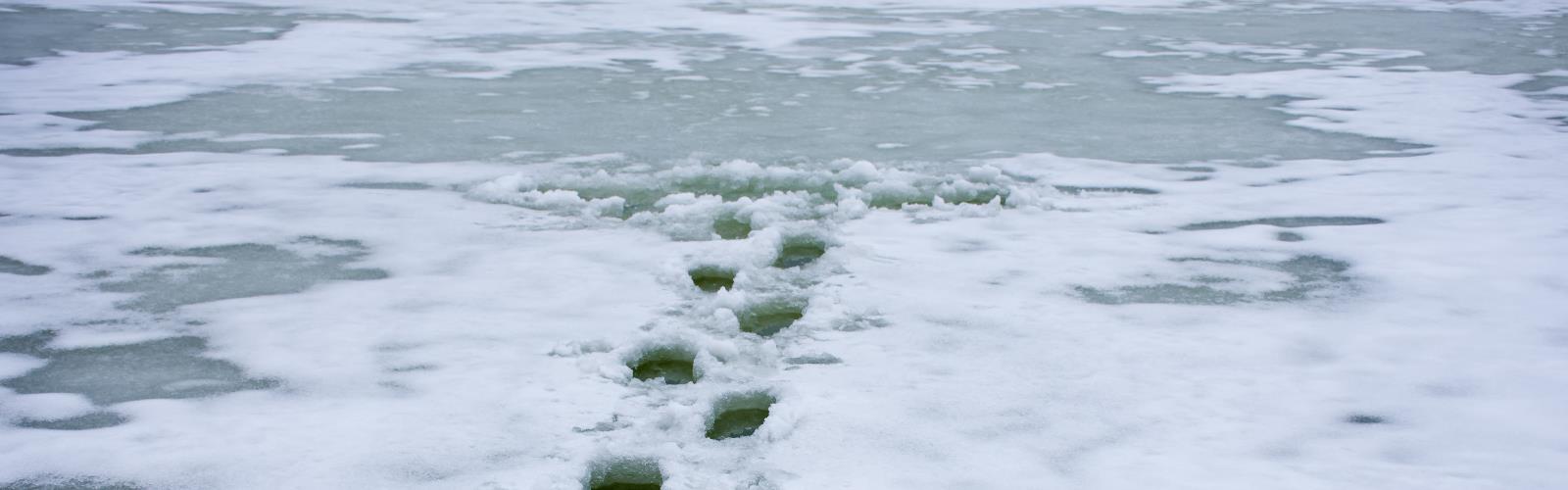
- Whitish or opaque ice (contains air bubbles, therefore more fragile)
- Areas where snow melted more quickly
- Visible cracks, even small ones
- Cracking sounds under your steps
- Water seeping through the ice
The 7 crucial steps to survive a fall through ice
Alright, here we go. These 7 steps are what can make the difference between going home with a good story to tell or... well, not going home at all. I've memorized them and I strongly advise you to do the same.
Step 1: Don't panic and control your breathing
Cold shock is your first enemy. Your body will want to hyperventilate, your heart will race, and you'll feel like your lungs are contracting. It's normal, but it's also what kills most people.
As soon as you hit the water, force yourself to hold your breath for 10-15 seconds. This will allow your body to adapt to the shock. Then breathe slowly and deeply. I know, it's easier said than done, but it's crucial.
Step 2: Orient yourself toward your arrival direction
It may seem obvious, but in stress and cold, you quickly lose your bearings. The ice you came from was solid enough to carry you that far. So it's your best chance to get out of there.
Absolutely avoid trying to swim toward shore if you're far away. Ice water will sap your strength in just a few minutes.
Step 3: Adopt the horizontal position
This is where it gets technical. Instead of trying to hoist yourself vertically (which will break even more ice), you must lie horizontally in the water, arms extended on the solid ice.
This position distributes your weight over a larger surface and prevents you from breaking more ice. It's counter-intuitive, but it works.
Step 4: Exit the water with kicking movements
Now, you'll use your legs as if you were swimming freestyle, but keeping your arms on the ice. The leg kicks will help propel you up and forward.
The idea is to get your torso out of the water first, then roll onto solid ice. It may take several attempts - don't give up.
Step 5: Roll onto solid ice
Once you've managed to get your torso out, absolutely don't stand up. Roll on the ice keeping your arms and legs spread to distribute your weight. Continue rolling until you're at least 3 meters from the hole.
Step 6: Crawl to safety
Even far from the hole, the surrounding ice may be weakened. Crawl on your belly toward shore or toward an area you know is safe. Take your time, even if you're cold.
Step 7: Treat hypothermia immediately
Once safe, you have about 15-20 minutes before hypothermia becomes really dangerous. Remove your wet clothes, put on dry clothes if you have them, and seek heated shelter as quickly as possible.
| Time in ice water | Physical capacity | Priority action |
|---|---|---|
| 0-2 minutes | Cold shock | Control breathing |
| 2-15 to 20 minutes (depending on water temperature and your physical condition) | Maximum strength | Get out of water quickly |
| 15-45 minutes | Loss of dexterity | Seek shelter |
| 45+ minutes | Severe hypothermia | Urgent medical assistance |
Equipment that can save your life on ice
After experiencing some extreme situations on the frozen lakes of Charlevoix, I've developed my own safety equipment list. Some items are absolutely essential, others are bonuses that can make the difference.
Basic equipment:
- Ice picks (two small awls connected by a rope)
- Rescue rope of 15-20 meters minimum
- Change of clothes in a waterproof bag
- Distress whistle
- Phone in a waterproof case
Ice picks are probably the most important tool. They give you a solid grip on the ice to pull yourself out of the water. You can buy commercial ones or make them with large nails and cork handles.
For the rescue rope, make sure it floats and stays flexible in extreme cold. I learned the hard way that a rope that becomes stiff as a branch is pretty useless when you need it.
How to help someone who fell through ice
Seeing someone fall through ice is one of my worst nightmares. But if it happens in front of you, your instinct will be to run help them directly. Fatal error. You'll just end up in the same mess.
The golden rule: Reach, Throw, Row, Go. In that order, not otherwise.
Reach
If the person is close to the edge, extend a branch, ski pole, anything long and solid. Lie flat on your stomach to distribute your weight and crawl toward them without ever exceeding the safe zone.
Throw
Throw them a rope, garden hose, even your clothes tied together. The important thing is to keep your distance while giving them something to grab onto.
Row
If you have access to a boat or even a large plank, use it to approach. But only if the first two options have failed.
Go
This is the last resort: physically going into the water to save the person. This should only be done by trained rescuers with appropriate equipment.
"In an ice rescue situation, patience can save two lives: the victim's and yours."
Get the guide →
Managing hypothermia after falling in ice water
Once out of the water, the fight isn't over. Hypothermia can kill you as surely as drowning, but it just gives you a little more time to react. I've seen guys who thought the worst was over once out of the water, then found themselves in severe hypothermia 30 minutes later.
The first signs of hypothermia to watch for:
- Uncontrollable shivering
- Mental confusion or impaired judgment
- Clumsiness in movements
- Difficult speech
- Drowsiness
What to do immediately:
First, remove all wet clothing. I know it seems counter-intuitive at -20°C, but wet clothes will suck your body heat 25 times faster than cold air. Better to be naked and dry than clothed and wet.
Then, warm up gradually. No hot shower, no direct fire on skin. Start by protecting your torso with dry clothes, then add layers gradually.
For outings on frozen lakes like those found near Parc national des Hautes-Gorges, I always bring a warming kit in my vehicle: blankets, dry clothes, thermos of hot liquid.
Fatal mistakes to absolutely avoid
After 15 years frequenting Quebec's frozen lakes, I've seen (and made) quite a few mistakes. Some are embarrassing, others can cost you your life. Here are the ones that still make me shudder when I think about them.
Mistake #1: Trying to exit by hoisting vertically
This is the classic mistake. You panic, you try to get out like you're getting out of a pool. Result: you break even more ice and exhaust yourself quickly. I saw a guy spend 10 minutes breaking ice instead of getting out because he stubbornly wanted to exit "standing up."
Mistake #2: Removing boots in water
It seems logical: your boots are heavy and full of water. But they also give you buoyancy and protect your feet from extreme cold. Keep them until you're completely out of the water.
Mistake #3: Shouting instead of whistling
Shouting in the cold exhausts your vocal cords quickly and doesn't carry as far as you think. A whistle carries for kilometers and requires almost no energy.
Mistake #4: Going alone on ice
I plead guilty to this one. How many times I went solo for a quick ice fishing session "real quick." If something happens and nobody knows where you are, your survival chances drop drastically.
Now, even for a 2-hour outing, I always tell someone where I'm going and when I plan to return. And if possible, I bring a buddy. It's more fun anyway.
| Situation | Common mistake | Good approach |
|---|---|---|
| Fall in water | Panic and hyperventilate | Control breathing 10-15 sec |
| Exiting water | Hoist vertically | Horizontal position and rolling |
| Call for help | Shout loudly | Use a whistle |
| Warming up | Direct intense heat | Gradual warming |
When and how to call for help
Calling for help when you're in ice water isn't like calling to report a car accident. You have very little time, your fingers don't work anymore, and you can lose consciousness quickly. Your call needs to be effective on the first try.
Call 911 immediately if:
- You can't get out of the water after 2-3 attempts
- You're alone and nobody knows where you are
- You're starting to lose sensation in your limbs
- You see someone else in distress
When you call, give this information in this order:
- Your precise location (lake, nearest road access)
- Number of people involved
- Situation status (in water, out but hypothermic, etc.)
- Your phone number in case the line cuts
If you have a GPS or an app like What3Words, use it. Saying "I'm on Lake So-and-so near the red cabin" is much less precise than giving exact coordinates. I've seen rescues delayed by 30 minutes just because rescuers were searching in the wrong place.
For my outings in more isolated places like lakes around Mont Arthabaska, I always bring a satellite communication device. It's expensive, but when there's no cell network, it's your only link to rescue services.
Prevention: how to avoid falling through ice
The best survival technique is still never having to use it. After all these years frequenting frozen bodies of water, I've developed prevention reflexes that allow me to enjoy winter while minimizing risks.
My verification routine before each outing:
I always start by checking weather conditions for the last 7 days. A day at +5°C followed by a night at -15°C can create treacherous ice: hard on surface but weak underneath. Environment Canada sites give detailed info I use to plan my outings.
Then, I test ice progressively. I start near shore with my walking stick, then advance in small segments. If I hear cracking or if my stick pierces easily, I turn back without discussion.
Zones I systematically avoid:
- Near docks and structures (water moves more around obstacles)
- Shallow bays (ice is often thinner there)
- Under bridges (wind creates currents)
- Areas with vegetation visible under ice
For group activities, I insist we stay spaced at least 10 meters from each other. It's not antisocial, it's common sense: if ice gives way under one person, others can help without risking falling too.
Surviving a fall through ice is a set of techniques I sincerely hope you'll never have to use. But now that you know them, you can enjoy winter activities with more confidence and safety.
Summary of essential points:
- Master the 7 survival steps: control your breathing, orient yourself, adopt horizontal position, use your legs to exit, roll on ice, crawl to safety, treat hypothermia
- Always equip yourself with ice picks, rope and spare clothes
- To help someone: Reach, Throw, Row, Go - in that order only
- Prevent hypothermia by removing wet clothes and warming gradually
- Prevention remains your best protection: test ice, avoid dangerous zones, never go alone
Quebec winter offers us incredible experiences on our frozen lakes and rivers. Whether for ice fishing, snowshoe hiking, or simply admiring winter landscapes, this safety knowledge will allow you to fully live your adventures. As I always say: better to be prepared and never need it than the opposite.
So this winter, get outside, explore our magnificent frozen bodies of water, but do it safely. And if you have experiences or techniques to share, don't hesitate to share them - we all learn from each other outdoors!

About the author
François Dumaine
Founder of Let's Go Play Outside
A passionate hiker, photographer and content creator, François has been hiking the trails of Quebec and Alberta since 2014. He founded Let's Go Play Outside to give you the information he wished he had before heading out.
Newsletter
Content that makes you want to go outside
Every week, a trail idea, a reflection on nature, or a tip worth the detour. Zero spam. Only the essentials.
Joined by 12,000+ outdoor enthusiasts
Read next
Continue the journey