Why observing animals in Quebec is child's play?
You know what struck me after 15 years of hiking Quebec's trails? It's that the easiest animals to observe in Quebec are everywhere around us, but we often miss them because we don't know where to look. La Belle Province is teeming with species accessible to beginners, and some are so common that with a minimum of patience, you're practically guaranteed to spot them. The secret? Start with species that don't hide! Unlike moose or lynx that require special conditions, several Quebec animals are active during the day and not very shy. I've compiled for you the easiest species to observe, with my favorite spots and field tricks.
💡 Pro tip — Always start your animal observations in urban and peri-urban parks. Animals there are used to human presence and much less skittish than in the wild.
The 8 easiest animals to observe in Quebec
The red squirrel: the all-around champion
If you're looking for a 99% guarantee of observing a wild animal, the red squirrel is your best bet. These little energy balls are present in all Quebec parks and are active from sunrise to sunset. Where to find them:The eastern chipmunk: the little forest clown
Shyer than the squirrel but just as charming, the eastern chipmunk is easy to spot thanks to its distinctive stripes. It loves rummaging through dead leaves looking for nuts.The great blue heron: elegance by the water
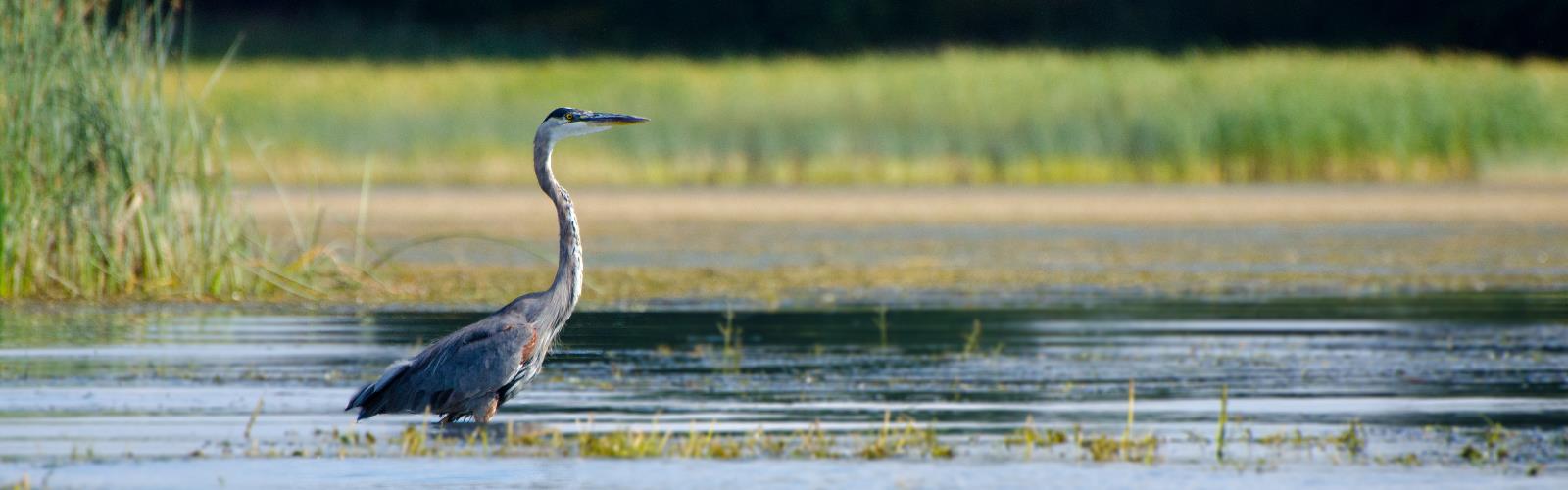
Impossible to miss with its 1.2-meter wingspan! The great blue heron frequents all Quebec water bodies. It stays motionless for long minutes, making it a perfect subject for observation and photography. Best spots:| Animal | Best period | Preferred habitat | Difficulty |
|---|---|---|---|
| Red squirrel | Year-round | Coniferous forests | Very easy |
| Eastern chipmunk | May to October | Mixed forests | Easy |
| Great blue heron | April to October | Water bodies | Easy |
| Canada goose | March to November | Urban parks | Very easy |
| Groundhog | May to September | Clearings, fields | Easy |
The Canada goose: impossible to miss
These geese have become so common in our parks that they're almost invasive! They have no fear of humans and walk around in families on lawns.The groundhog: the field sentinel
Nicknamed "whistler" because of its piercing alarm call, the groundhog is easy to observe in clearings and field edges. It often stands on its hind legs to survey the surroundings.
📌 Good to know — Groundhogs hibernate from October to April. That's why we say they "come out of their hole" in spring!
The northern flicker: the forest jackhammer
This colorfully plumed woodpecker is bigger than you think and relatively unafraid. Its characteristic undulating flight and loud calls make it easy to spot.The raccoon: the masked bandit
Mostly active at dusk, the raccoon frequents waterways and... camping garbage cans! It's a curious animal that doesn't hesitate to approach humans.The striped skunk: to observe... from afar!
Very common but often avoided for obvious reasons, the skunk is actually easy to observe. It walks slowly and doesn't really hide.
⚠️ Warning — Always keep a minimum distance of 10 meters from a skunk. If it raises its tail, back away immediately!
What time to go out to maximize your chances?
After hundreds of outings, I've noticed that timing is crucial for animal observation. Most mammals are more active during the cool hours of the day.The golden morning hour (6am-9am)
This is THE magic period. Animals come out to feed after the night, the air is cool and calm, and you'll often have the trails to yourself. Why it's so effective:Late afternoon (4pm-7pm)
Second peak period! Animals come out for their "dinner" and are often less nervous than in the early morning.To avoid: 11am-3pm
It's nap time for most animals. They hide in the shade and move very little. I've made the mistake too often of leaving in full heat and coming back empty-handed."The best time to observe animals is when you don't really want to get out of bed. But trust me, it's worth every minute of lost sleep!"
📥 Download our free guide — The 15 easiest animals to observe in Quebec, with maps of the best spots and photo tips.
Get the guide →
Get the guide →
The best habitats for beginners
Not all habitats are equal for animal observation. After testing dozens of places, here are my recommendations to maximize your chances from your first outing.Urban parks: your training ground
It's counter-intuitive, but city parks are perfect for beginners. Animals there are used to humans and much less skittish. My favorite spots:Forest edges: the transition zone
This is where forest meets fields or clearings. This transition zone attracts a great diversity of species because it offers both food and shelter. What to look for:Water bodies: wildlife oasis
Rivers, lakes, marshes... all animals need water! That's why water bodies are guaranteed hot spots for observation. Winning strategy: Find a water point and set up at a distance. Let the animals come to you rather than chasing them.Less frequented trails
The more popular a trail is, the fewer animals you'll see. It's mathematical! I always favor secondary trails or off-peak hours on popular trails.
💡 Pro tip — Avoid main trails on weekends. Take the small connecting trails or lesser-known variants instead. You'll see 10 times more animals!
Essential equipment (and what's useless)
Good news: you don't need to spend a fortune to observe animals! Here's what really works in the field, tested and approved after years of costly mistakes.The essentials
8x42 binoculars: This is tool number 1. The 8x42 is the sweet spot between magnification and stability. I've been using the same ones for 10 years and they've never let me down. Neutral clothing: Forget fluorescent red and bright white. Brown, green, gray... anything that blends into the scenery. My hunting clothes work perfectly. Silent shoes: Soft soles that don't crack on branches. My old trail shoes are perfect for that.What really helps
What's useless (and what I bought by mistake)
| Equipment | Approximate price | Usefulness | Priority |
|---|---|---|---|
| 8x42 binoculars | $150-300 | Essential | High |
| Neutral clothing | $0 (you already have some) | Very useful | High |
| ID app | Free | Very useful | Medium |
| Camera | Variable | Useful | Medium |
| Notebook | $10 | Useful | Low |
Approach techniques that work
Observing animals is 20% luck and 80% technique. Here are the methods I've perfected over the years that make all the difference between a successful outing and an ordinary walk.The 3 S rule: Stop, Scan, Silence
Stop: Stop regularly, even for no apparent reason. Most people walk too fast and miss everything. Scan: Slowly sweep your gaze from left to right, then up and down. Look for movements, unusual shapes, colors that stand out. Silence: Avoid talking, turn off your cell phone, walk slowly. Sound carries far in the forest.The improvised blind technique
Find a comfortable spot (stump, rock, bench) with a good view and don't move for 15-20 minutes. It's amazing how animals resume their normal activities when they think you're gone! My favorite spot: A big flat rock near a stream at Mont du Lac des Cygnes. I've seen deer, groundhogs and even a fox there.The zigzag approach
Instead of charging straight at a spotted animal, approach in zigzag while pretending to be interested in something else. Animals are less suspicious when they don't feel directly targeted.
⚠️ Warning — Never follow or harass an animal. If it moves away, it wants to be left alone. Respect its comfort zone!
The false departure trick
When you spot an animal that has spotted you, pretend to leave in the other direction. Wait 2-3 minutes hidden behind a tree. Often, the animal resumes its activities and you can observe it longer.My secret spots in Quebec
After 15 years exploring the province, I have my little magic corners where I'm almost sure to see animals. I'm revealing my 5 favorite spots, but shh... keep this to yourself!The Parc Michel-Chartrand marsh
This is my number 1 spot near Montreal. The marsh trail is a real open-air zoo: herons, ducks, muskrats, painted turtles... Best time: Early morning on weekdays What you'll see: Guaranteed herons, beavers if you're luckyThe Mont-Yamaska clearings
Mont Yamaska hides several small clearings perfect for groundhogs. They come out to warm up in the sun around 8am. My trick: Take the Tower trail, but stop in the clearings before reaching the summit.The Canyon Sainte-Anne banks
Canyon Sainte-Anne isn't just spectacular for its falls. The upstream banks are teeming with flying squirrels (if you're lucky!) and birds.The Parc du Mont-Arthabaska prairies
Parc du Mont-Arthabaska has alpine prairies where I've seen red foxes several times. Autumn is particularly productive there.The Hautes-Gorges bogs
In Parc national des Hautes-Gorges, the bogs accessible by the L'Équerre trail are perfect for observing marsh birds.
📌 Good to know — Each season offers different observations. Keep a list of animals seen by month, you'll be surprised by the patterns that emerge!
Photographing without disturbing
Animal observation and photography often go hand in hand, but it must be done intelligently. Here are my golden rules developed after too many beginner mistakes.The distance rule
Photo settings that save the day
Shutter priority mode: 1/500s minimum to freeze movements High ISO: Don't be afraid to go up to 1600-3200 ISO Continuous autofocus: To track moving animals Burst mode: Animals move fast, multiply your chancesWhat you should NEVER do
"The best animal photo is one where the animal doesn't know it's being photographed."
Adapting to seasons
Each season in Quebec offers its own observation opportunities. Adapting your strategy according to the time of year is key to maximizing your chances.Spring (April-May): nature's awakening
This is THE season to start! Animals emerge from their winter torpor, are active and less skittish. Leaves haven't come out yet, which facilitates observation. To observe: Groundhogs emerging from hibernation, migratory birds, very active squirrelsSummer (June-August): abundance
Period of maximum activity, but also dense vegetation that complicates observation. Favor water bodies and clearings. To observe: Animal families with their young, waterfowl, insects (and therefore their predators)Fall (September-October): winter preparation
Animals build up their winter reserves and are very active. Autumn colors make observation even more magical. To observe: Squirrels hiding nuts, migrating birds, animals changing coatsWinter (November-March): the specialists
Fewer active species, but those that are can be easily seen on snow. It's the season of tracks and traces! To observe: Tracks in snow, birds at feeders, hares turning whiteYour first steps toward observation
Observing Quebec animals is accessible to everyone and starts with your next outing. Here's your action plan to get off on the right foot: • Start local: Your neighborhood park hides more animals than you think • Get up early: The best observations happen before 9am • Stay patient: 20 minutes of immobility is worth more than 2 hours of fast walking • Equip yourself simply: 8x42 binoculars and neutral clothing are enough • Note your observations: You'll quickly see patterns emerge Animal observation has completely transformed how I experience the outdoors. Instead of just "doing" a trail, I now live each outing. Every rustling of leaves becomes a possibility, every silence an opportunity. So, ready to discover the Quebec wildlife that surrounds you? Choose one of the spots I suggested, set your alarm an hour earlier than usual, and go see what's waiting for you outside. I guarantee you'll never look at nature the same way again!
About the author
François Dumaine
Founder of Let's Go Play Outside
A passionate hiker, photographer and content creator, François has been hiking the trails of Quebec and Alberta since 2014. He founded Let's Go Play Outside to give you the information he wished he had before heading out.
Newsletter
Content that makes you want to go outside
Every week, a trail idea, a reflection on nature, or a tip worth the detour. Zero spam. Only the essentials.
Joined by 12,000+ outdoor enthusiasts
Read next
Continue the journey