
A Look at the Different Faces of Mountain Biking
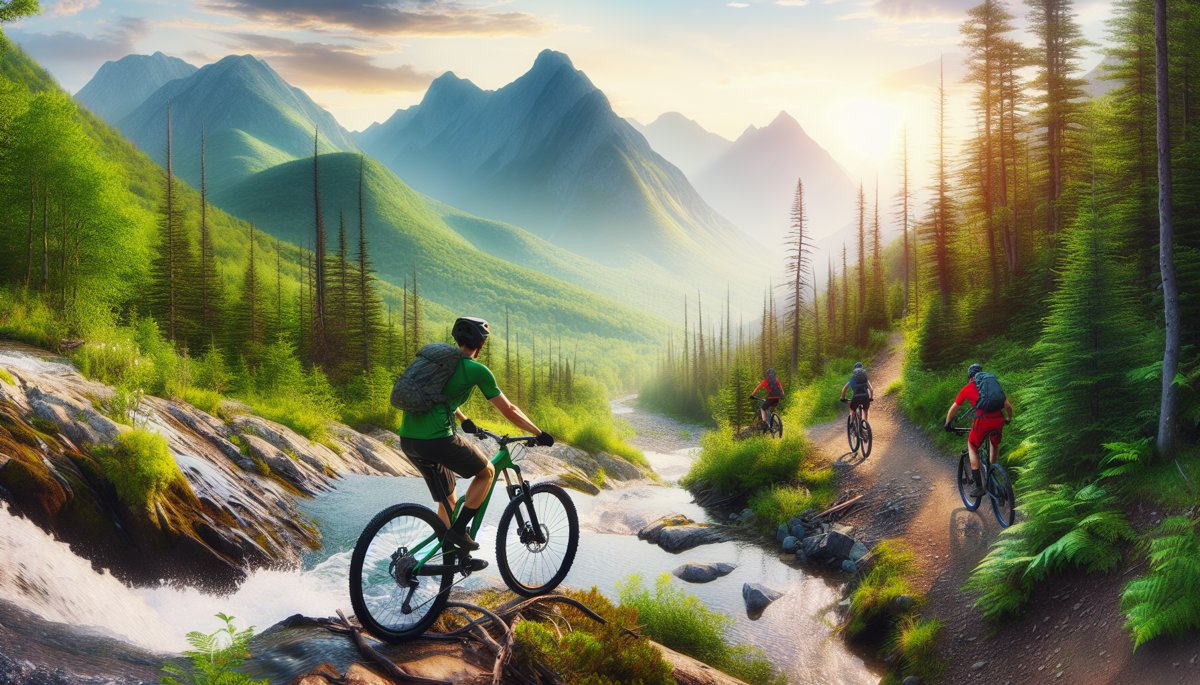
It's been since the 1950s that the first rebels took to dirt trails to travel far from cities. Mountain biking was born first out of necessity.
It was in California in the 1970s that the first bikes were adapted to the particular conditions of nature trails.
Derailleurs, knobby tires and suspension are now innovations from this movement that bring joy to cyclists of all kinds. The bicycle is the most efficient motorless means of transportation and its user-friendliness continues to gain followers worldwide.
Mountain biking hasn't escaped this wave and its popularity has since taken incredible momentum by diversifying. It's become such a widespread sport around the world that it's been made an Olympic discipline!
Why go to all this trouble?
The difficulty of the trails, the physical effort and the technical level necessary to develop to truly appreciate this sport makes it one of the most fascinating thrill activities.
But the main appeal of mountain biking is being able to taste the joy of finding yourself in nature, having the opportunity to face the elements in order to master them.
Mountain biking enthusiasts won't be outraged by a mud puddle, they'll rather do everything to roll through it. It's a sport that reconnects you to your inner child.
Wind is a negligible aspect for the mountain cyclist who finds under the vegetation cover a welcoming shelter. It's the topography and natural layout of nature that gives each trail its unique characteristics.
And while the sport has diversified greatly since its beginnings and highlights slightly different interests according to our nature, at its core mountain biking responds to the same need: that of pushing the limits of the human body and mind within nature.
To give you an overview of the different options available to you in mountain biking, I present here the 4 main variants of this surprising sport.
- Cross-country
Cross-country is the most versatile of the 4 types of mountain biking and certainly the most accessible to everyone.
You practice it to explore new places, push yourself on climbs, increase your concentration on narrow and rough trails, but also have time to appreciate the nature around you.
Since you're looking for physical challenge as much as technical challenge, you power all your movements with elbow grease, and if this leads you to work hard on climbs, you know you'll be rewarded by the view at the summit and the exhilaration on the descent.
You can also practice this type of biking on less steep terrain to allow you to cover greater distance or for outings that are a bit less physically demanding. Cross-country is the most suitable variant for introducing your friends to mountain biking.
The cross-country bike is lightweight. For better comfort and increased control, it usually features front suspension or dual suspension (front and rear), but with low travel (100 to 130 mm) so as not to hinder your pedaling too much, particularly on climbs where suspension can prove quite cumbersome.
On a cross-country bike, you'll have access to at least 24 speeds (3 chainrings in front and 8 in back) to handle the sudden changes that will present themselves on your route.
The user-friendliness of cross-country means it can be practiced almost anywhere. It can provide you with a very appreciable degree of comfort on our paved roads whose condition isn't always safe. It's the ultimate all-rounder!
Downhill
In downhill, your main concern during your first experiences will certainly be staying alive! The pursuit of speed and technical challenge are undoubtedly the two aspects that most characterize this type of cycling.
Since the ideal bike for this type of trail is heavier to ensure certain stability due to numerous trail obstacles, the downhill cyclist won't appreciate climbs. Since their objective is to reach the bottom while mastering obstacles, they'll resort to lift services to reach the summit.
It's therefore a sport where trail options are much more limited than cross-country. It's a mountain biking variant that will lead you to spend a bit more money to practice it, because in addition to the bike and equipment being more expensive, mechanical lifts aren't free!
In addition to its superior weight, the downhill bike will have full suspension (front and rear) with high travel (190 to 200 mm), a more robust frame, wider tires with more aggressive knobs and won't use as many gears (one chainring in front is largely sufficient, since it's primarily gravity doing the work).
If this type of extreme cycling suits you well, you'll be wise to use more complete protective equipment including body armor, knee pads, elbow guards as well as a helmet that covers the entire head (full face).
Downhill biking has its own variant called freeride which emphasizes the technical challenges of the course. The goal is to challenge the cyclist's skills in different balance challenges to push limits ever further with the aim of becoming one with your bike.
Enduro
Enduro (also known as all mountain) is a mountain biking discipline that sits between cross-country and downhill. The term enduro, borrowed from motocross, describes a course mainly consisting of descents that emphasizes the technical side.
The enduro cyclist seeks speed but must also be in good enough physical condition to maintain momentum on climbs.
In enduro, your course can also be enhanced with man-made obstacles like bridges and walkways to allow you to push your concentration abilities and sense of balance ever further.
The enduro bike is similar to that used for downhill, but its suspension will have slightly less supple travel (140 to 160 mm) to be more efficient on climbs, because after all, it's the enduro cyclist's desire to handle their own ascents that distinguishes them from the downhill rider.
The "fatbike"
The fatbike is a mountain bike whose frame and forks have been adapted to oversized knobby tires that allow the cyclist to pedal more efficiently on less stable surfaces like sand or snow.
Mainly designed for winter pedaling, you usually practice fatbiking on groomed snow trails with preferably flat terrain, because even though its tires are very wide, they lose much grip on climbs.
Designed to coexist with snowshoers and cross-country skiers, its colossal tires offer much resistance to the cyclist who shouldn't expect to reach high speeds on a fatbike saddle.
Due to its comfort, robust nature and versatility, more and more enthusiasts use it in summer on mountain bike trails.
However, its simplistic mechanics designed to survive harsh winter climate don't offer as precise performance as downhill or cross-country bikes.
But since it benefits from irresistible popular enthusiasm due to the invincible character that its frame conveys, it's a safe bet that technical improvements will make it an even more widespread companion among all types of cyclists in coming years.
Conclusion
In closing, know that regardless of the style you choose to explore, the outdoor enthusiast in you has everything to gain by getting caught up in the mountain biking game.
Climbing a summit while advancing on a human-built object grows within you a feeling of accomplishment that's difficult to describe.
Being able to swim under a waterfall after pedaling for hours is a pleasure of an intensity that can't really be understood without having lived it. The gifts we receive during a mountain biking adventure are countless, but above all, they're often unexpected.
Much more than an opportunity to learn a new sport, mountain biking offers you a new perspective on life. It's the opportunity to launch into an adventure filled with surprises and twists that will surely push you to discover the brightest parts of your being.
With its different faces, mountain biking will lead you to discover all sides of the mountain of your capabilities.
What are you waiting for, jump on your bike and go explore nature like you've never done before!
Sources:
https://guides.wiggle.fr/cassette-velo
https://www.chinookaventure.com/histoire-velo-de-montagne/
http://www.velo.qc.ca/montagne/Le-velo-de-montagne-explique
25 hikes under 2 hours from Montreal
Distance, elevation, parking and season for each one. The ones we go back to ourselves.
Get the guide
About the author
François Dumaine
Founder of Let's Go Play Outside
A passionate hiker, photographer and content creator, François has been hiking the trails of Quebec and Alberta since 2014. He founded Let's Go Play Outside to give you the information he wished he had before heading out.
Get our best guides
One article per week to level up your outdoor game. No spam, promise.
You might be interested in
🥾 AlexHike.ca: A Website That Left Its Mark on Quebec Hikers
🧭 Bougex.com: When Community Was at the Heart of the Outdoors
10 Amazing Camping Spots You Should Discover
Back to Basics
Breaking In Your Shoes
Complete 3-Day Bivouac Story on the Sentier National in Mauricie: Unforgettable Adventure, Challenges and Discoveries
Complete Story of My 4-Day Jacques-Cartier Park Traverse: Itinerary, Challenges and Practical Tips
Dancing in the Rain - 7 Tips to Encourage You to Play Outside When It's Raining
