
A Sound Mind in a Sound Body
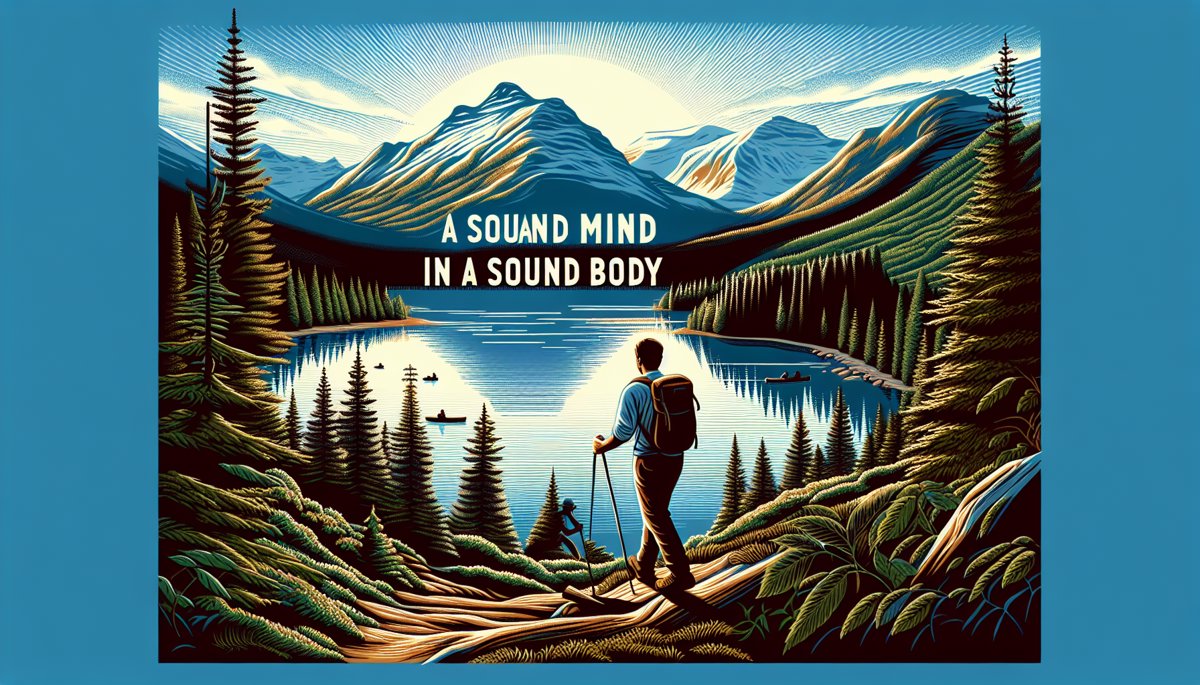
Sometimes, we feel like certain sayings just spin around empty in our heads. We hear these clichéd phrases so often that something in us resists every time these "wise" words reach our ears.
Yet, there are some clichéd phrases that really hit home. The expression: a sound mind in a sound body is, for me, an example of a phrase that sums up life well.
And today I want to share with you everything this simple phrase inspires in me.
Where does it come from?
Contrary to what you might think, it wasn't Pierre de Coubertin who invented this quote. It was a guy named Juvenal who supposedly wrote it around 100 years after Jesus Christ. And in its original meaning, it refers to the spiritual dimension of human health.
The idea is that the body is our temple on earth and that there's no point in seeking answers to our existential questions through the quest for recognition or through religious practices if we can't be at peace with everything that defines us in the first place, namely: our physical and mental health.
And for me it's undeniable, the balance of body and mind go together.
If you're infested with harmful thoughts, or you can't find purpose in your life, there's a good chance your life choices don't benefit your physical health.
The reverse is also true. If you neglect your physical health, it's likely that dark thoughts haunt you for a good part of the day. Like an athlete who plays with restraint when suffering an injury, you're not quite yourself when your body isn't at its best.
Concretely, what does this change in my life?
Good physical and mental health allows you to adapt more easily to your environment and therefore experience less stress, which means that in a healthy body, you're better able to recognize and express your needs.
Man is determined by his thoughts. The problem is that most of the time you're not aware that you have a health problem that diminishes your abilities or that harmful thoughts are creating damage in your body. The reason is simple.
You've been conditioned to think in terms of others and you've forgotten how to feel what's happening inside you.
This leads you to confuse needs and emotions.
For example, the sensation of thirst or hunger expresses bodily needs, but can be conditioned by the mind. You just need to look at an advertisement showing food to "feel" hungry just fifteen minutes after leaving the table.
The sensation is very real, but it's not the body that's hungry, but the mind seeking to fill a void. And most of the time this void isn't physical, but emotional.
We've been conditioned to fill emotional needs by taking measures to fill physical needs. Here are some examples of behaviors that support the idea that we act against our own well-being without being fully aware of it:
• Eating to numb pain;
• Consuming alcohol or drugs to numb a sense of malaise;
• Taking unnecessary risks or disrespecting others to draw attention to oneself;
• Compulsively buying objects we don't need to fight stress, boredom or to boost our self-esteem;
• Keeping things for ourselves, when they're useless to us and others would need them, all to avoid the stress of leaving the ephemeral comfort they provide.
A matter of survival
These survival strategies aren't evil in themselves. They can even serve to maintain a certain balance necessary for our healing if they're used sparingly and with kindness.
Now you'll think I'm playing psychologist or life coach and you'll probably be right. There have been so many positive things that have happened in my life since I put outdoor activities at the top of my priority list that I want everyone to get up and discover the inner well-being it brings.
I know, I know, it's not that easy to change.
The problem is that our destructive behaviors have grafted onto our values and have sometimes even become socially encouraged, conditioned. This makes us lose sight of the fact that in our lives, we spend a lot of time and energy chasing an ideal that meets others' needs and will never fulfill us.
You just need to look at people's addiction to technology and social media to realize this.
All this because we haven't learned to interpret and listen to our emotions and we let ourselves be influenced by external pressures. Most of the time, we're content to do what everyone else does without understanding the impulses that guide most of our behaviors.
What are emotions for?
Emotions serve to inform us about the body's needs. Emotional needs (being heard, being able to express oneself, feeling useful and loved) are just as important as physical needs (breathing, drinking, eating, reproducing).
The problem with our emotions (this is also true for bodily needs) is that the rules of life in society require us to be able to understand our emotions and physical needs before being able to express them freely.
This means you intellectually interpret almost all the sensations that overwhelm you throughout the day, without allowing yourself to fully experience them.
When you're always in your head, it always takes a good reason to do certain things, especially if these actions lead you to leave your comfort zone. In short, you always eat the same dishes and repeat the same gestures because you know what to expect, not necessarily because it's good for you.
You seek to experience a known positive emotion because it gives you the illusion of having control over your life, it preserves you from the stress of the unknown.
How to give meaning to your life
Sometimes we seek to give meaning to what we've accomplished instinctively. It's in the absence of rational explanation that our mind begins to wander. To evolve, we sometimes have to accept taking instinctive actions that apparently make no sense.
Taking care to balance body and mind is a very effective way to simplify your life while giving it meaning.
When you have the best of both body and mind, all other parts of your being are available. Under these conditions, you can accomplish anything.
Before getting back in shape, just a few years ago, I would never have believed myself capable of climbing Kilimanjaro or reaching Everest base camp. Yet, I managed it by getting back in shape one step at a time. And the more my body strengthened, the more my mind was able to accept bigger challenges!
If I was able to leave my comfort zone to get back in shape, it's because I listened to that little voice telling me I had everything to gain. Rationally, this challenge made no sense, but instinctively, I knew the adventure would be beneficial. That's what allowed me to hang on when I was experiencing difficulties.
Vitality is an attitude
You've surely already noticed that the physical age of the body is very often linked to a question of attitude. People who preserve their child's heart stay active in all spheres of their life. At every moment, they create games, opportunities to evolve consciously.
By setting goals, you stimulate the life force within you.
It's as if you're telling your cells: I'm alive, I need you to continue growing.
Keeping morale up or staying positive helps keep your mind motivated on the task to accomplish. Every second you advance toward your goal with the conviction of getting closer to it. Each concrete proof you give to your rational mind makes it more flexible.
Moving is thanking your cells for keeping you alive, but above all it's the best way to clear your mind of the seriousness that pollutes it.
A sound mind in a sound body is all you have to do to give meaning to your life.
Sources:
http://www.canalvie.com/maigrir-pour-gagner/un-esprit-sain-dans-un-corps-sain-1.1754993
https://fr.wikipedia.org/wiki/Mens_sana_in_corpore_sano
https://fr.wikipedia.org/wiki/Mens_sana_in_corpore_sano
https://www.quebec.ca/sante/conseils-et-prevention/saines-habitudes-de-vie/activite-physique

25 hikes under 2 hours from Montreal
Distance, elevation, parking and season for each one. The ones we go back to ourselves.
Get the guide
About the author
François Dumaine
Founder of Let's Go Play Outside
A passionate hiker, photographer and content creator, François has been hiking the trails of Quebec and Alberta since 2014. He founded Let's Go Play Outside to give you the information he wished he had before heading out.
Get our best guides
One article per week to level up your outdoor game. No spam, promise.
You might be interested in

🥾 AlexHike.ca: A Website That Left Its Mark on Quebec Hikers

🧭 Bougex.com: When Community Was at the Heart of the Outdoors

10 Amazing Camping Spots You Should Discover



Back to Basics

Breaking In Your Shoes

Complete 3-Day Bivouac Story on the Sentier National in Mauricie: Unforgettable Adventure, Challenges and Discoveries

Complete Story of My 4-Day Jacques-Cartier Park Traverse: Itinerary, Challenges and Practical Tips

Dancing in the Rain - 7 Tips to Encourage You to Play Outside When It's Raining
