
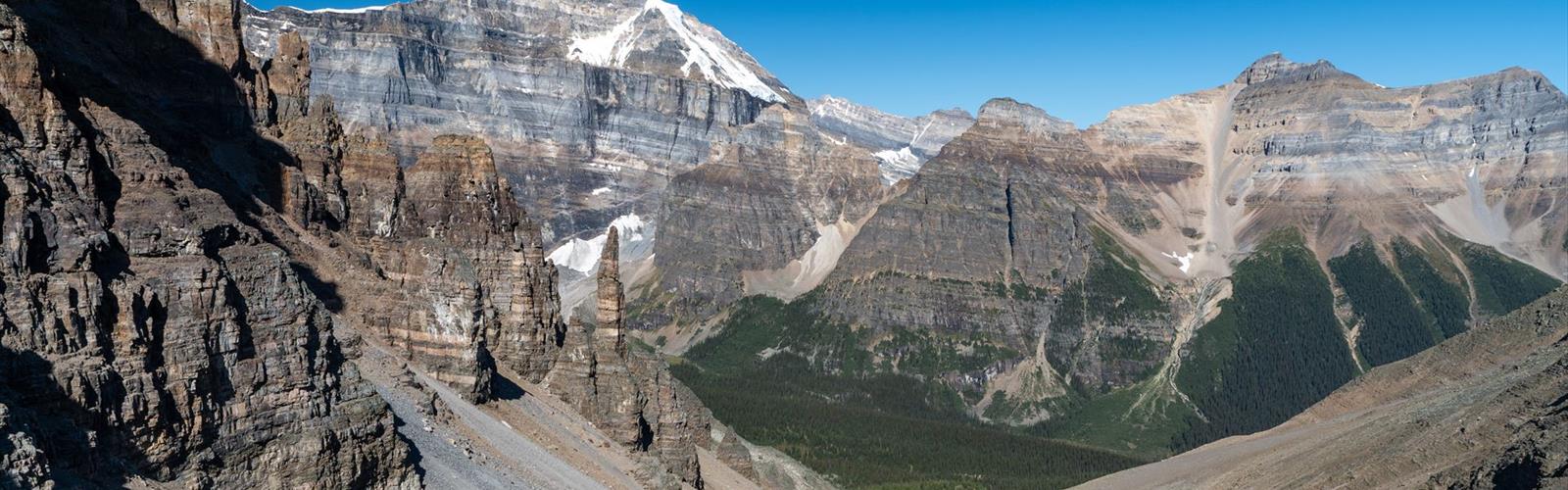

Ready to explore Mount Temple? Here's everything you need to know before you go!
Discover the trail
Photos: Christoph Strässler from Oberdorf BL, Schweiz — CC BY-SA 4.0 (Wikimedia Commons)
Trail description
Mount Temple is one of the most iconic and challenging peaks in the Canadian Rockies, rising to 3,543 meters above sea level in Banff National Park, Alberta. Its unmistakable pyramid silhouette dominates the skyline along the Trans-Canada Highway, making it one of the most recognizable summits in the range. Named after Sir William Temple, a British statesman and diplomat, the mountain saw its first recorded ascent in 1894 when J. Norman Collie and James Outram reached the top. Since then, it has become one of the most sought-after objectives for experienced scramblers and alpine climbers in the Canadian Rockies.
This is a highly challenging technical scramble, not a hiking trail. The typical approach via Moraine Lake involves approximately 1,150-1,620 meters of elevation gain over a 16-kilometer round-trip, with an estimated time of 10-12 hours. This is a serious alpine undertaking that should only be attempted by those with solid scrambling experience, good fitness levels, and proven alpine judgment. The terrain includes sustained exposure, demanding boulder fields, loose rock, and sections requiring confident footwork on steep terrain high above the valley.
Routes to the Summit
Mount Temple offers several distinct lines to the top, each with its own character and set of challenges. The North Ridge is the most popular route and also one of the most technically demanding scrambles in the Canadian Rockies. It involves sustained exposure, narrow ridge sections, and moves that require confident footwork on steep rock high above the valley. This is not a route where hesitation serves you well.
The Southwest Ridge is often considered the more approachable option, though it still demands respect and proper preparation. Route-finding is a real factor here, and the terrain doesn't forgive poor decisions. The East Face offers a more direct line but is equally committing. Regardless of which route you choose, the ability to read terrain and adapt your line in real time is essential — fixed markers are not going to guide you up this mountain.
The Approach and Terrain
The approach begins at Moraine Lake parking lot, following the lakeshore trail past Moraine Lodge before gaining the main ridge system. The initial approach traverses alpine meadows and transitions quickly into scree and boulder fields. Loose rock is a constant companion on the lower sections, and rockfall awareness matters both for your own footing and for the parties below you. As you gain elevation, the terrain opens up into more exposed ridge and face climbing where the consequences of a slip increase significantly.
Rock quality is inconsistent throughout. Some sections offer solid, confidence-inspiring holds, while others present fractured or crumbly rock that demands extra care with every placement. The upper mountain tends to be where the most technical moves concentrate, and it's also where route-finding becomes most critical. Getting off-route near the summit is a real possibility if visibility drops or fatigue sets in.
Snow lingers on upper sections well into summer, and ice can form even during warmer months. Crampons and an ice axe may be necessary depending on conditions and timing. The combination of altitude, exposure, and variable rock and snow conditions means your gear list needs to be thought through carefully before you leave the trailhead. Many parties recommend bringing helmets due to loose rocks and potential rockfall hazards.
Timing and Weather
An early start is not optional on Mount Temple — it's a core part of the strategy. Most parties should be moving well before dawn to give themselves enough time for both the ascent and a safe descent before afternoon weather rolls in. Thunderstorms build quickly at this elevation, and being caught on an exposed ridge during a lightning event is a serious situation. The 10-12 hour estimated duration reinforces how much time this mountain demands.
Mid-August is considered the best time to attempt Mount Temple, when rock conditions are typically most favorable and snow coverage is minimal. Late summer and early fall can also offer good conditions, but afternoon storm patterns remain a consistent concern throughout the season. Checking the forecast carefully and committing to a turnaround time before you start are both non-negotiable habits on a mountain like this.
Gear and Preparation
A helmet is essential — rockfall is a genuine hazard, both from natural causes and from other parties above you. Sturdy boots with solid grip are a baseline requirement, and many climbers carry a rope for the more exposed sections along with basic climbing hardware. Layering for rapidly changing mountain weather is standard practice, as temperatures at summit elevation can shift dramatically over the course of a day.
Navigation skills matter here. The descent route may not follow the same line as the ascent, and knowing your options before you're tired and the weather is closing in makes a real difference. Familiarity with map and compass, or a reliable GPS device with the route loaded, adds a meaningful layer of safety on a mountain where the terrain can look very different on the way down.
The View from the Top
If conditions cooperate, the summit of Mount Temple delivers a panorama that covers an enormous sweep of the Canadian Rockies. The Bow Valley stretches out far below, and peaks like Mount Assiniboine, Mount Rundle, and the summits along the Continental Divide fill the horizon in every direction. Lake Louise sits to the northwest, its turquoise water visible as a vivid contrast against the surrounding rock and forest. The Wapta Icefield spreads across the skyline, a reminder of the glacial forces that shaped this entire landscape. On a clear day, the view reaches deep into British Columbia, with range after range fading into the distance.
It's the kind of summit view that makes the early alarm, the loose scree, and the exposed ridge feel entirely worth it — provided you've put in the preparation to get there safely.
The Essential Hiking Checklist
Everything you need for your next hike. Bilingual, printable, 1 page.
Get your free hiking checklistRecommended gear for this trail
As an Amazon Associate I earn from qualifying purchases.


Ready to go?
Everything you need to know before you goStarting Point
The mount temple is located in the Rocky Mountains of Alberta, Canada. The easiest way to get to the start of the trails is to drive to the town of Banff and then take the Mount Norquay Road to the ski area. There is a parking lot at the ski area where you can park your car and then start hiking.
When?
How much?
As an Amazon Associate I earn from qualifying purchases.
Affiliate links — LGPO may earn a commission at no extra cost to you.
- Hiking shoes Essential
- → Salomon Elixir Tour Mid WP · 203.38 $
- Layered clothing Essential
- Rain jacket Essential
- Trekking poles
- → Black Diamond Trail Ergo Cork · 69.99 $
- Headlamp
- → Petzl Actik Core 625 · 103.95 $
FAQ - Frequently asked questions
Everything you need to knowSimilar hikes nearby
Discover other trails you might enjoy
Fossil Mountain
Canadian Rockies

Snake Indian Mountain
Canadian Rockies
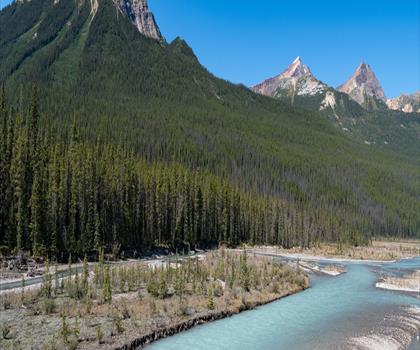
Mushroom Peak
Canadian Rockies
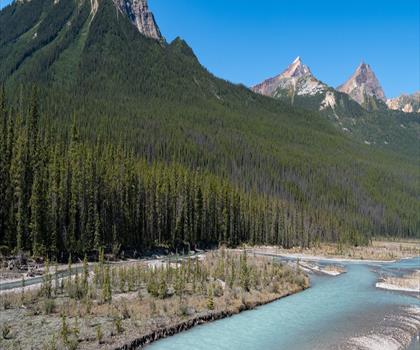
Mount Woolley
Canadian Rockies
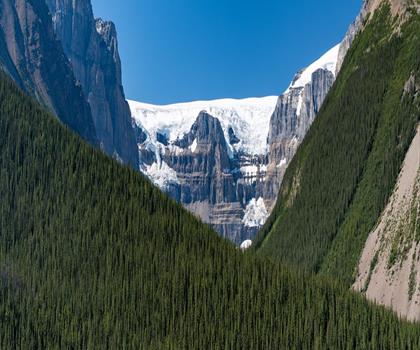
Stutfield Peak
Canadian Rockies
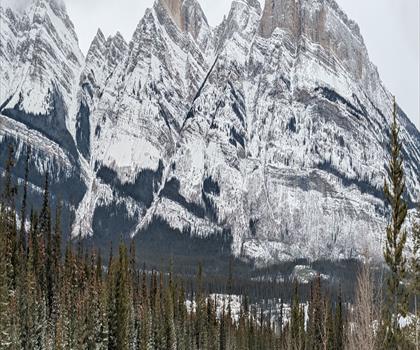
Mount Sarbach
Canadian Rockies
Hiking near Banff
187 trails to explore ~48 km away
We work hard to provide the most up-to-date and error-free data possible. If something seems incorrect, let us know! Your contribution helps the whole community.
Hikers' opinions
Be the first to review!
No hiker has shared their experience yet. Share your impressions and help other hikers!