
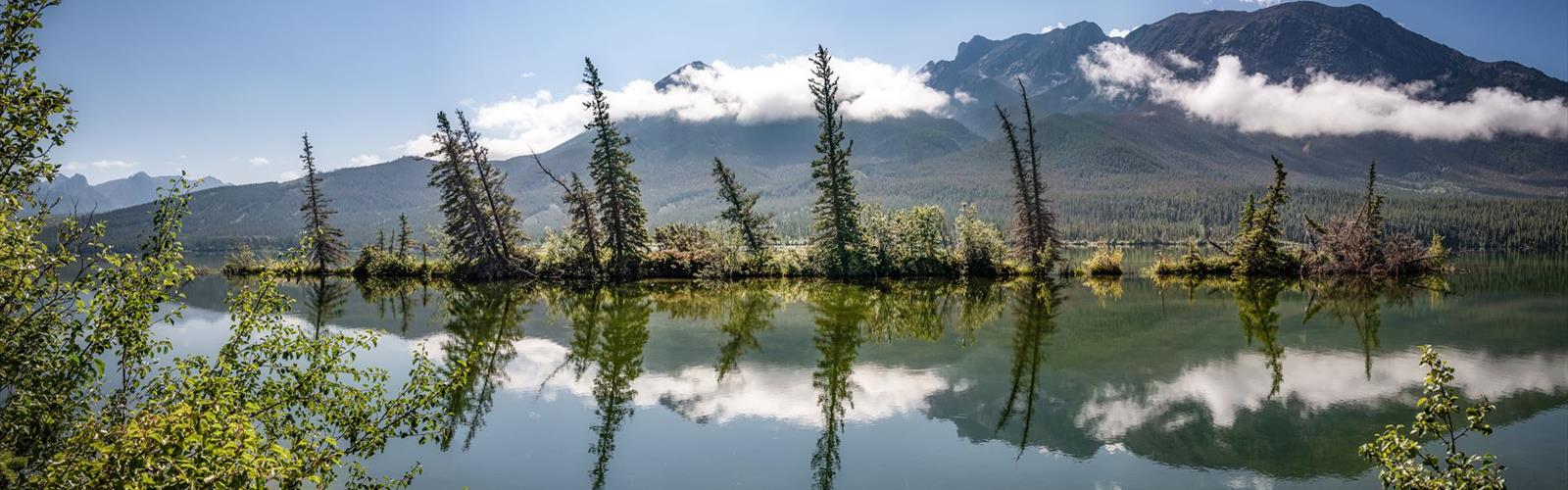

Ready to explore Roche Jacques? Here's everything you need to know before you go!
Discover the trail
Trail description
Roche Jacques rises dramatically from the heart of Jasper National Park, its distinctive silhouette cutting an unmistakable profile against the Alberta sky. This towering peak stands as one of the Canadian Rockies' most recognizable landmarks, drawing hikers into a landscape where ancient limestone meets endless wilderness. Its imposing presence dominates the surrounding valley, creating a natural amphitheater of stone and forest that feels both intimate and overwhelming in equal measure.
The mountain's name reflects the French heritage woven throughout this region's history, and it has served as a navigation point for travelers crossing these mountains for generations. What sets Roche Jacques apart from other peaks in Jasper isn't just its height — it's the way the entire landscape seems to organize itself around this single dramatic formation.
The Route
At 11.2 km with 2,591 m of elevation gain, this is a serious undertaking. The estimated time of 10 hours 30 minutes should be treated as a realistic baseline for fit, experienced hikers moving at a steady pace — not a target to beat. The difficulty rating is Hard, and the numbers back that up. The elevation gain alone puts this route in the same category as some of the most demanding day hikes in the Canadian Rockies.
The approach begins through dense montane forest, where lodgepole pine and Douglas fir create a canopy that filters the mountain light into shifting patterns on the trail below. This lower section gives your legs a chance to warm up before the terrain gets serious. As you gain elevation, the forest gradually opens into subalpine meadows — during the brief growing season, these clearings fill with wildflowers that make for a striking contrast against the rock faces above.
Higher up, the trail becomes increasingly demanding. Rocky outcrops punctuate the landscape, and the evidence of glacial action is everywhere — polished rock surfaces, U-shaped valleys, terrain that has been carved and reshaped over millennia. Above treeline, the route can become less defined, and the landscape takes on a stark, almost austere quality that rewards the effort it took to get there. Navigation skills matter here; the alpine zone above Roche Jacques is not the place to be figuring out your compass for the first time.
Wildlife and Natural Features
Jasper National Park's wildlife population is well represented in the terrain surrounding Roche Jacques. Elk are frequently spotted in meadows and forest clearings, especially during early morning and evening hours. In autumn, their bugling during rutting season adds an unforgettable layer to the experience. Mountain goats navigate the steep upper terrain with their characteristic indifference to exposure, and both black bears and grizzly bears inhabit this region — bear awareness isn't optional here, it's fundamental.
Smaller wildlife is equally present. Pikas call from talus slopes, marmots whistle from their boulder perches, and golden eagles ride thermals above the sun-warmed rock faces. Moose occasionally appear in wetter areas and small lakes scattered through the valley systems below.
The plant communities shift noticeably with elevation. Lower sections feature typical boreal forest species, while the subalpine zone brings alpine flowers — mountain avens, moss campion, alpine forget-me-nots — that bloom quickly and intensely during the short window between snowmelt and the return of cold. These aren't delicate garden plants; they're tough, low-growing species built for conditions that would flatten most vegetation.
Planning Your Visit
Given the elevation gain and total distance, an early start is not just recommended — it's essential. Mountain weather in this part of the Rockies moves fast. A clear morning can shift into afternoon thunderstorms or sudden temperature drops with very little warning. Layered clothing and waterproof gear are non-negotiable, regardless of what the forecast says when you leave the trailhead.
The hiking season typically runs from late June through early October. Snow can linger at higher elevations well into July and return as early as September, so conditions on the upper sections of the route can vary significantly even within the main season. Early season often means muddy trails and swollen stream crossings from snowmelt; late season brings the risk of early winter storms and icy conditions on exposed terrain.
Navigation tools — map, compass, and ideally a GPS device — are worth carrying and knowing how to use. Above treeline, trails can become obscure, and reduced visibility from weather can happen quickly. Cell coverage in this area is unreliable at best.
Safety and Practical Considerations
Hiking with a partner is strongly advisable on a route of this length and difficulty. Solo hikers should leave a detailed plan — trailhead, intended route, expected return time — with someone reliable before heading out. An emergency communication device adds a meaningful safety margin in terrain where help is not close.
Bear spray should be carried and accessible, not buried at the bottom of a pack. Food and scented items need to be stored properly; Jasper National Park enforces food storage requirements, and for good reason given the active bear population in this area.
Water sources are generally abundant along the route, but all natural water should be treated before drinking. The streams and lakes may look clean, but filtration or purification tablets are necessary to avoid waterborne illness. Carry enough water to get you through sections where sources may be sparse, particularly on the upper alpine terrain.
Leave No Trace principles apply throughout — pack out all waste, stay on established trails where they exist, and camp only in designated areas if an overnight is part of the plan. The condition of this terrain depends directly on how visitors treat it.
The Essential Hiking Checklist
Everything you need for your next hike. Bilingual, printable, 1 page.
Get your free hiking checklistRecommended gear for this trail
As an Amazon Associate I earn from qualifying purchases.


Ready to go?
Everything you need to know before you goStarting Point
The roche jacques is located in the Kananaskis Country of Alberta. To get to the start of the trails, take the Trans-Canada Highway west from Calgary and exit at the Kananaskis Village turnoff. Follow the signs to the roche jacques.
When?
How much?
As an Amazon Associate I earn from qualifying purchases.
Affiliate links — LGPO may earn a commission at no extra cost to you.
- Hiking shoes Essential
- → Salomon Elixir Tour Mid WP · 203.38 $
- Layered clothing Essential
- Rain jacket Essential
- Trekking poles
- → Black Diamond Trail Ergo Cork · 69.99 $
- Headlamp
- → Petzl Actik Core 625 · 103.95 $
FAQ - Frequently asked questions
Everything you need to knowSimilar hikes nearby
Discover other trails you might enjoy
Fossil Mountain
Canadian Rockies

Snake Indian Mountain
Canadian Rockies
Mushroom Peak
Canadian Rockies
Mount Woolley
Canadian Rockies
Stutfield Peak
Canadian Rockies
Mount Sarbach
Canadian Rockies
Hiking near Jasper
82 trails to explore ~20 km away
We work hard to provide the most up-to-date and error-free data possible. If something seems incorrect, let us know! Your contribution helps the whole community.
Hikers' opinions
Be the first to review!
No hiker has shared their experience yet. Share your impressions and help other hikers!