The magic of the outdoors... and the frustration of not knowing how to capture it
You know that feeling? You reach the summit after two hours of climbing, you contemplate that breathtaking panorama, you pull out your phone or camera... and the result completely disappoints you. That magnificent view becomes flat, dull, soulless on your screen. I've experienced this hundreds of times in my first years on the trail. My practical tips for taking successful outdoor photos, I learned them the hard way, by missing more shots than I'd like to admit! But today, after covering thousands of kilometers with my camera slung over my shoulder, I can tell you there are simple techniques to transform your outdoor photos into memories you'll truly be proud of. In this guide, I'll share my field tricks for capturing the essence of your adventures, whether you use a phone or a DSLR. Because our nature outings deserve better than blurry and poorly framed photos!Why your mountain photos never look like your memories?
That's THE question all hikers ask themselves! And the answer is simpler than we think: our eye sees differently than a photo sensor. When you admire a landscape, your brain composes an image by scanning the scene, constantly adjusting brightness, focusing on details that move you. Your camera, on the other hand, freezes everything at once in a rectangular frame. It can't reproduce that visual dynamic you feel in the field.
💡 Pro tip — Before shooting, close one eye and look at the scene as if you were looking through a frame. It helps you see what your camera will actually capture, without the "bonuses" your brain adds!
The secret is learning to compose for your camera, not for your eyes. That changes everything! Instead of wanting to fit everything in the frame, focus on the element that made you pull out your camera. That sparkling waterfall? That summit piercing through the clouds? That golden light on autumn leaves?
I understood this during an outing at Mont Yamaska. I was desperately trying to capture the entire valley, but my photos were flat. Then I isolated just the ridge line with clouds grazing it. Bingo! That photo is still hanging in my living room.
The 3 magical moments when light transforms your shots
If you remember only one thing from this article, let it be this: light does 80% of the work for you. No matter your equipment, if you shoot at the right moments, your photos will go from "decent" to "wow".Morning golden hour (30 minutes after sunrise)
This is my favorite moment! The light is soft, warm, and gives incredible texture to landscapes. Shadows are long but not too contrasted. Perfect for mountain portraits and panoramic landscapes. The challenge? You need to be there early. Very early. But trust me, it's worth the 5 AM wake-up call! I took my best photos at Mont du Lac des Cygnes during those precious 30 morning minutes.Evening golden hour (1 hour before sunset)
More accessible than the morning one, but often more crowded. The light gradually becomes warmer and more dramatic. It's the ideal moment for silhouettes and backlighting.
📌 Good to know — Download an app like "Golden Hour" or "Sun Surveyor" to know exact times based on your position. It avoids unpleasant surprises!
Blue hour (20 minutes after sunset)
Less known, but magical! The sky takes on that unique deep blue tint, and if there's still some light on the landscape, the contrast is striking. Perfect for lake photos with reflections or mountain silhouettes.| Moment | Best for | Difficulty | My advice |
|---|---|---|---|
| Morning golden hour | Panoramas, portraits | High (early wake-up) | Prepare your gear the night before |
| Evening golden hour | Backlighting, silhouettes | Medium | Arrive 1h early to scout |
| Blue hour | Reflections, moods | High (low light) | Use a tripod or brace yourself |
Rule of thirds and other composition tricks that change everything
Let's talk composition! This is where your photos go from "I was there" to "look how beautiful it was". The good news? The basic rules are simple and work every time.Rule of thirds: your best friend in the mountains
Imagine your screen is divided into 9 equal sections by two horizontal and two vertical lines. Place important elements on these lines or at their intersections. The horizon on the bottom line (to emphasize the sky) or the top (for the foreground). This works particularly well for mountain lakes: place the water line on the lower third and position a striking element (rock, tree, hiker) at an intersection.Leading lines: guide the eye where you want
A winding trail, a flowing river, a ridge stretching to the horizon... Use these natural lines to guide the gaze toward your main subject. It's super effective and adds depth to your images.
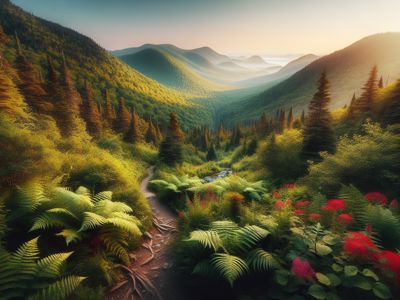
💡 Pro tip — S-shaped trails are your best allies! They create natural composition that attracts the eye and tell a story of movement and adventure.
The importance of foreground
This is the mistake I made all the time at the beginning: I focused on the distant mountain and forgot what was at my feet. Result? Flat photos without depth. Now, I always look for an interesting element to place in the foreground: rocks, wildflowers, tree roots. It gives dimension and contextualizes the landscape's scale. At Canyon Sainte-Anne, I took one of my favorite photos by including ferns in the foreground. It gives the impression of really being in the scene!
📥 Download our free gifts — The complete list of photo equipment to bring hiking, with all my favorite settings for each situation.
Get my gifts →
Get my gifts →
Phone vs camera: which to choose for your adventures?
Ah, the great debate! After dragging pounds of photo equipment in the mountains for years, then switching to phone for certain outings, I can give you the real scoop on this question.Phone advantages for hiking
Weight and simplicity: That's the killer argument. Zero extra grams in your pack, and you always have it to capture the unexpected. Recent phones work miracles, especially in good light. Automatic portrait mode: For photos of your team at the summit, it's formidable. The bokeh effect (blurred background) happens automatically. Instant sharing: If you have signal, you can share your best moments live. It's fun to motivate friends to join you!When camera makes the difference
Optical zoom: To capture that distant marmot or isolate a landscape detail, nothing beats real zoom. With a phone, you lose quality as soon as you zoom. Difficult conditions: Backlighting, low light, high contrast scenes... Camera handles these situations better thanks to its larger sensor and manual settings. Battery life: No stress about draining your battery with photos. Your phone stays available for navigation and emergencies.
⚠️ Warning — If you're going with your phone as the only camera, bring a power bank! Nothing more frustrating than missing the sunset because your phone died.
My field recommendation
For day trips with planned scenic viewpoints: compact or mirrorless camera. Weight remains reasonable and quality is there. For multi-day treks or "discovery" outings: phone + clip-on lenses. You keep the lightness while having more creative options.Essential settings that will transform your photos
Okay, let's talk technical, but just the essentials! No need to be a pro to master these few settings that make all the difference in the field.Aperture priority mode: your go-to mode
It's the "A" or "Av" mode on your camera. You choose the aperture (the famous f/), and the camera calculates the rest. Why is it great? Because aperture controls depth of field, and that's crucial in landscape photography. f/8 to f/11: The sweet spot for landscapes. Everything is sharp, from foreground to infinity. It's my default setting for 80% of my mountain photos. f/2.8 to f/4: To isolate a subject (a flower, rock detail) with blurred background. More creative, but use sparingly.Light metering: avoid blown-out photos
Your camera tries its best, but sometimes it gets it wrong. In mountains, with snow or water reflections, it tends to underexpose. Use exposure compensation (the +/- button) to adjust.
💡 Pro tip — Look at the histogram on your screen after each photo. If there's a spike stuck to the right, you're "blowing out" the highlights. Better to slightly underexpose and recover in post-processing.
Focus: where to place sharpness
In landscape, use single-point focus and place it on the main element of your composition. If you want everything sharp from foreground to background, focus on the hyperfocal distance (about 1/3 into the scene).ISO: your ally when light drops
Always start at ISO 100 for maximum quality. Gradually increase if you need faster shutter speed:| Situation | Aperture | ISO | Advice |
|---|---|---|---|
| Sunny landscape | f/8-f/11 | 100-200 | Full auto mode OK |
| Sunrise/sunset | f/8 | 400-800 | Watch the histogram |
| Mountain portrait | f/4-f/5.6 | 200-400 | Focus on the eyes |
| Waterfall/moving water | f/8-f/16 | 100 | Slow shutter (tripod needed) |
How to capture action and movement outdoors
Static photos are fine, but sometimes you want to show the energy of your adventures! Capturing movement is an art, but with a few simple techniques, you can create images that really tell your outdoor stories.Shutter speed: your magic tool
It controls how movement appears in your photos. Fast, it freezes action. Slow, it creates artistic blur. To freeze action (jumping, running, frozen waterfall): 1/500s or faster. Often requires raising ISO, but the result is worth it. To create movement (silky water, streaming clouds): 1/2s to 30s with mandatory tripod. It's magical on waterfalls!Panning: following the movement
Pro technique I love using with runners or cyclists: you follow your subject with the camera while shooting (speed around 1/30s). Subject stays sharp, background becomes blurred. It gives an incredible sense of speed!
📌 Good to know — For waterfalls, start at 1/4s and adjust according to desired effect. Slower makes water more cotton-like. Too slow, and you lose water texture.
I had great results with this technique at Chutes Jean Larose. By following a hiker crossing in front of the waterfall, I created this sense of movement that really makes you want to move!
Photographing wildlife: patience and respect above all
Ah, wildlife photography! It's probably what gives me the most adrenaline while hiking. But be careful, it requires a completely different approach and above all, total respect for our furry and feathered friends.The golden rule: keep your distance
Never less than 100 meters with large mammals (bears, moose, deer). For birds, adapt according to species, but if the animal changes behavior because of your presence, you're too close. I learned this the hard way during an outing in Hautes-Gorges de la Rivière Malbaie. A magnificent moose, but I was too close. It stressed and fled. I learned my lesson!Equipment that makes the difference
Telephoto lens or zoom: Essential to keep your distance. 200mm minimum, 300mm is better. On phone, use digital zoom sparingly. Stabilization: At these focal lengths, the slightest shake shows. Optical stabilization, breathing technique, or brace against a tree.
⚠️ Warning — NEVER feed a wild animal for a photo. It's dangerous for you and conditions the animal. Plus, it's illegal in most parks!
Favorable moments
Early morning and late afternoon: Animals are more active, and light is more beautiful. Double benefit! Near water sources: Especially in summer, animals come to drink. Set up at good distance and wait patiently. Breeding seasons: More activity, but also more risks. Animals are less predictable."The best wildlife photo shows the animal in its natural behavior, without stress, in its environment." — My mantra after 15 years of nature photography
Post-processing: enhance without distorting
Post-processing is like seasoning in cooking: well-dosed, it enhances. Too much, it ruins everything. My approach? Reveal what was already there, not invent what wasn't.Basic adjustments that change everything
Exposure and contrast: Always start here. Brighten or darken globally, then adjust contrast to add punch. Highlights and shadows: Recover details in very bright or very dark areas. It's magical for mountain photos with dramatic skies. Vibrance rather than saturation: Vibrance boosts dull colors without exploding those already vivid. More natural!My favorite tools
Lightroom Mobile: Perfect for post-processing on phone. Intuitive interface, pro results. Snapseed (free): Simple but effective. Ideal for starting without breaking the bank. Lightroom Classic: For large volumes and more advanced retouching on computer.
💡 Pro tip — Create your own presets! Once you find a style you like, save the settings. It'll save you tons of time and give consistency to your photos.
The "less is more" rule
If someone looks at your photo and thinks "wow, that's retouched," you've gone too far. The goal is for people to think "wow, that's beautiful" without thinking about technique. I have a personal rule: if I hesitate between two versions (one more natural, one more "punchy"), I always choose the more natural one. Our Quebec landscapes are already beautiful enough as they are!Ideal photo equipment for hiking (without breaking the bank)
Let's talk gear! After testing (and carrying) tons of equipment on trails, here are my recommendations for different budgets and levels.Beginner setup (under $500)
Recent phone + Moment clip lenses: Light and versatile solution. Wide-angle lens perfect for landscapes, telephoto for isolating subjects. Expert compact: Canon PowerShot G7X, Sony RX100... Excellent image quality, featherweight, optical zoom. My choice for long treks.Intermediate setup ($500-1500)
APS-C mirrorless + 18-55mm lens: Sony a6000, Fuji X-T30, Canon M6... DSLR quality in compact format. Kit lens sufficient to start. Light carbon tripod: Essential for long exposures and summit self-portraits!Expert setup ($1500+)
Full-frame mirrorless + 24-70mm f/4: Sony a7 III, Canon R6... For those who want maximum quality. 70-200mm telephoto: For wildlife and isolating landscape details.
📌 Good to know — Buy used! Photo equipment resells well and you can get very good gear at reduced prices. I bought my first DSLR used, it served me well for 8 years!
Life-changing accessories
Peak Design strap: No more bouncing camera! It stays accessible but secure. Polarizing filter: Eliminates reflections, saturates colors, darkens sky. Magical on water and foliage. Backup battery: Because running out of power at sunset is infuriating!| Budget | Main equipment | Total weight | Advantages |
|---|---|---|---|
| < $500 | Phone + clip lenses | < 200g | Ultra-light, always available |
| $500-1500 | APS-C mirrorless + 18-55mm | 600-800g | Optimal weight/quality balance |
| > $1500 | FF mirrorless + pro lenses | 1-2kg | Maximum quality, versatility |
My beginner mistakes (so you can avoid them!)
Alright, a bit of humility! I'll tell you about my biggest photo blunders in the mountains. It'll help you avoid making the same ones, and at least my mistakes will have served some purpose!Mistake #1: Wanting to photograph everything
My first treks, I shot everything! Every tree, every rock, every view. Result? 500 mediocre photos and a dead battery before noon. I learned that 20 good photos are better than 200 bland ones. Now, I force myself to think before pulling out the camera: what moves me in this scene? How to convey it? It revolutionized my practice.Mistake #2: Ignoring the weather
"It's gray, no point taking photos." Big mistake! Some of my favorite images were taken on overcast days. Clouds diffuse light, colors are saturated, atmosphere is dramatic. At Parc National du Mont Saint-Bruno, I got my most beautiful autumn shots in foggy weather. That mysterious atmosphere, impossible to get in bright sun!Mistake #3: Neglecting safety for THE photo
I almost fell several times wanting to get closer to a cliff or leaving the marked trail. No photo is worth an accident. Now, I strictly respect safety guidelines.
⚠️ Warning — If you have to say "careful, it's dangerous" to take your photo, you shouldn't take it! Find another angle, use zoom, but don't take unnecessary risks.
Mistake #4: Forgetting to enjoy the moment
Paradoxically, focusing too much on photography can make you miss the experience. It took me time to find balance between capturing and living the moment. My trick now: I start by contemplating without camera. I soak in the atmosphere, feel the emotion. Then I pull out the camera to try conveying it. My photos are better, and so are my memories!My secret photo spots in Quebec (shh!)
Well, they won't be secret after this, but oh well! Here are some lesser-known places where I took my favorite shots. Spots off the beaten path that offer unique angles on our beautiful landscapes.Mont-Royal's hidden lookout
Everyone knows Parc du Mont-Royal, but few know there's a small trail leading to an alternative viewpoint. Perfect for avoiding crowds and getting a different perspective on the city.Morning reflections at Parc Michel Chartrand
Parc Michel Chartrand at dawn is magical! Especially the small pond near the entrance. With mist rising and first rays breaking through, you have dream conditions for photography.Mont Arthabaska's secret angle
At Parc du Mont Arthabaska, instead of going straight to the summit, take the small detour to the east. You'll have an enfilade view of the entire Appalachian chain. Breathtaking in autumn!
💡 Pro tip — The best photo spots are often known by local hikers. Don't hesitate to ask advice from people you meet on trails. The outdoor community is generally very generous!
These places sometimes require a little extra effort, but that's exactly why they're less crowded. And trust me, having a magnificent spot all to yourself is priceless!
Your next photos will make people jealous!
There you have it, you now have all the keys to transform your outdoor outings into real photo sessions! Let's recap the essential points: • Light does 80% of the work — favor golden hours and don't fear bad weather • Compose with intention — rule of thirds, leading lines and interesting foreground • Respect wildlife — keep your distance and favor natural behavior • Less is more — in post-processing as in the field, sobriety pays • Safety first — no photo is worth an accident Most important? Get out and practice! All these tips are worthless if you stay home. Every outing is an opportunity to learn, progress, and above all create magnificent memories. Our Quebec landscapes are full of wonders just waiting for your lens. So charge your batteries, check your memory cards, and go show the world how extraordinary our corner of the country is! Next time you come back from a hike with photos that give you chills, you'll know you've succeeded. And who knows? Maybe your shots will inspire other people to discover the joys of the outdoors. That's the real magic of adventure photography!
About the author
François Dumaine
Founder of Let's Go Play Outside
A passionate hiker, photographer and content creator, François has been hiking the trails of Quebec and Alberta since 2014. He founded Let's Go Play Outside to give you the information he wished he had before heading out.
Newsletter
Content that makes you want to go outside
Every week, a trail idea, a reflection on nature, or a tip worth the detour. Zero spam. Only the essentials.
Joined by 12,000+ outdoor enthusiasts
Read next
Continue the journey