You know what strikes me most when I observe hikers on the trails? It's not those with the most expensive gear or the fanciest boots. It's those who move with fluidity, who seem to dance with the terrain, who arrive at the summit fresh as daisies while others are dragging their feet. After 15 years of exploring Quebec trails and beyond, I've understood that physical preparation, stretching and warm-up for hiking make all the difference between a magical outing and a day of suffering. And believe me, I've experienced both!
Today, I'm going to share everything I've learned on the trail to prepare your body to perform in the mountains. Because yes, hiking is a sport — and like any sport, it requires preparation.
Why your body needs to be ready before you go
I used to think hiking was just putting one foot in front of the other. Big mistake! I got my first real lesson at Mont du Lac des Cygnes. After 2 hours of climbing, my calves were screaming for mercy and my knees were starting to act up. That's when I realized my body simply wasn't prepared for the effort required.
Hiking challenges your body in unique ways:
- Your legs work continuously, often on irregular terrain
- Your heart pumps harder, especially at altitude
- Your joints absorb impacts and elevation changes
- Your back carries the weight of your pack for hours
- Your feet constantly adapt to terrain changes
The good news? With smart preparation, you can transform your outings. More endurance, less pain, and most importantly, more pleasure exploring our beautiful trails.
Your physical preparation: the basics that change everything
When I say physical preparation, I'm not talking about becoming an Olympic athlete. I'm talking about giving your body the tools to perform on the trail. Here's my approach, tested on hundreds of outings:
Cardio: your mountain engine
Your heart is your engine. The more efficient it is, the farther you can go without getting winded. My favorite exercises:
- Brisk uphill walking: find a nice climb near you and do it 2-3 times per week
- Stairs: go up and down for 20-30 minutes, perfect for simulating elevation gain
- Cycling: excellent for legs without too much joint impact
- Running: if your knees can handle it, it's great for endurance
Strength training: building solid foundations
No fancy gym needed. These bodyweight exercises work wonders:
| Exercise | Target Muscle | Repetitions |
|---|---|---|
| Squats | Thighs, glutes | 3x15-20 |
| Lunges | Legs, balance | 3x10 each leg |
| Calf raises | Calves | 3x20 |
| Plank | Core, back | 3x30-60 sec |
| Bridge | Glutes, back | 3x15 |
Balance: your insurance on technical terrain
On rocky trails like at Canyon Sainte-Anne, balance can literally save your day. My favorite exercises:
- Single-leg stands: 30 seconds, eyes closed to make it harder
- Line walking: as if walking on a beam
- Yoga or tai-chi: excellent for balance and flexibility
Warm-up: your pre-departure ritual
I admit, at first, I skipped this step. "Well, we'll walk slowly at the beginning, it'll warm up naturally!" Beginner's mistake. A good warm-up is like putting oil in a cold engine — it prevents many problems.
My trail warm-up (10-15 minutes)
Here's my routine, which I do religiously at the start of every trail:
Phase 1: Joint awakening (5 minutes)
- Ankle rotations: 10 in each direction
- Knee flexions: 10-15 repetitions
- Hip rotations: 10 in each direction
- Shoulder rolls: releases pack tension
- Neck rotations: gently, wake everything up
Phase 2: Muscle activation (5-10 minutes)
- Marching in place with high knees
- Light butt kicks
- A few slow, controlled squats
- Dynamic lunges
- Leg swings (front-back, lateral)
The idea is to reach the real start of the trail with your body purring like a well-oiled engine. You'll feel the difference from the first steps.
Get my gifts →
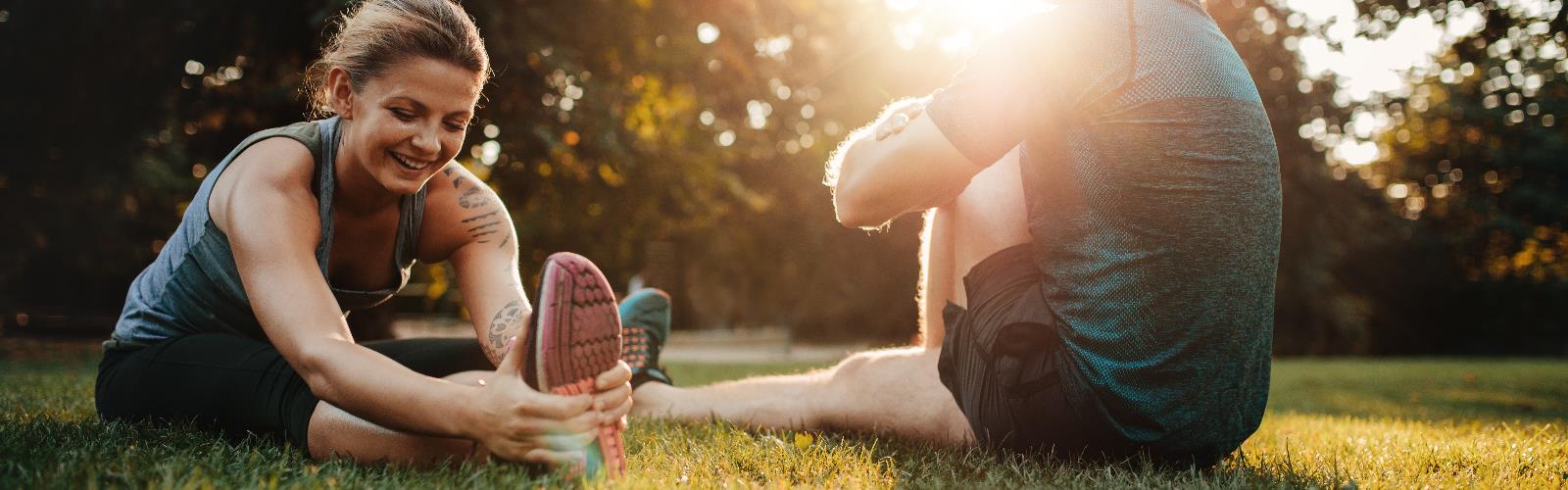
Stretching: your best friend after the effort
If warm-up prepares your body, stretching thanks it after the effort. It's your investment in your next outings. Neglect this step, and you'll pay for it in the days that follow.
Post-hike stretching (15-20 minutes)
My routine after every outing, whether at Mont Yamaska or elsewhere:
For the legs (critical zone):
- Calves: lean against a tree, leg extended behind (30 sec each leg)
- Quadriceps: standing, foot to buttocks, knee pointing down (30 sec)
- Hamstrings: seated, leg extended, lean forward (30 sec)
- Glutes: lying down, ankle on opposite knee, pull thigh (30 sec)
- Hips: deep lunge, let pelvis drop (30 sec)
For the upper body:
- Back: hang from a branch, let your weight stretch your spine
- Shoulders: arm crossed in front, pull with other arm
- Neck: gentle head tilts
Recovery stretching (same evening)
Once home, shower taken, it's the perfect time for a longer session. 20-30 minutes of gentle stretching, breathing deeply. Your muscles will thank you tomorrow.
"The unprepared body endures the mountain. The prepared body dances with it."
When and how to integrate all this into your routine
I know what you're thinking: "François, this is all well and good, but I don't have 3 hours a day to dedicate to my preparation!" Don't worry, neither do I. Here's how I organize my typical week:
Your realistic weekly schedule
| Day | Activity | Duration |
|---|---|---|
| Monday | Cardio (brisk walk/bike) | 30-45 min |
| Tuesday | Leg + core strengthening | 20-30 min |
| Wednesday | Rest or gentle yoga | 15-30 min |
| Thursday | Cardio + balance | 30-40 min |
| Friday | Full body strengthening | 25-35 min |
| Saturday | Hiking! | As the mood strikes |
| Sunday | Active recovery | 20-30 min |
My tricks to keep the rhythm
Because consistency is the secret:
- Start small: 15 minutes is better than nothing
- Vary the pleasures: stairs one day, park the next
- Find a buddy: it's more motivating with two
- Use your environment: office stairs, brisk walk to get coffee
- Listen to your body: fatigue = rest, no unnecessary heroics
The goal is to arrive at Parc National du Mont Saint-Bruno or any other trail with a body that's eager to move, not one that dreads the effort.
Adapting your preparation according to your goals
Not all hikes are equal, and neither is your preparation. A family stroll at Parc du Mont-Royal isn't the same game as an expedition in the Hautes-Gorges de la Malbaie.
Beginner level: your first steps
Goal: 2-4 hour hikes, moderate elevation gain
Preparation focus:
- Basic cardio: 2-3 outings per week, 20-30 minutes
- Light strengthening: bodyweight, 2x per week
- Stretching after every effort
- Get your feet used to it: wear your hiking boots regularly
Intermediate level: you're gaining momentum
Goal: 4-8 hour hikes, significant elevation gain
Preparation focus:
- Intensified cardio: intervals, steeper hills
- Targeted strengthening: legs, core, back
- Weighted training: loaded backpack
- Regular training outings
Advanced level: you're aiming for excellence
Goal: Multi-day treks, high mountains
Preparation focus:
- Structured program over 12+ weeks
- Specific training: altitude, heavy carrying
- Planned active recovery
- Performance tracking and adjustments
Never forget: the mountain will always be there. Better to arrive prepared and fully enjoy than to suffer from lack of preparation. Believe me, I've tested both approaches!
Mistakes to absolutely avoid
After all these years, I've seen all types of hikers. And believe me, certain mistakes keep coming back. Here are the traps you don't want to fall into:
The weekend warrior mistake
You know, that guy who sits all week and wants to compensate on Saturday with an 8-hour hike? I was that guy. Result: monster soreness, knees on fire, and temporary disgust with hiking.
The solution: Regularity > Intensity. Better 20 minutes 4 times a week than a 2-hour session on Sunday.
Skipping warm-up out of impatience
"Come on, we're wasting time, we'll warm up while walking!" How many times have I heard that... and how many times have I seen the same people complaining of pain 2 hours later.
Neglecting post-effort stretching
Arriving at the parking after a beautiful day, the urge is to go straight home. But those 15 minutes of stretching are your investment in your next outing.
Wanting everything, right away
Physical preparation is like good wine: it takes time. Wanting to go from sedentary to seasoned hiker in 2 weeks is the perfect recipe for injury.
My advice? Take your time. The mountain will wait for you, and you'll appreciate it all the more when you're well prepared to meet it.
The benefits that will surprise you
Beyond the obvious (less pain, more endurance), good physical preparation will transform your hiking experience in ways you can't even imagine:
Your trail confidence
When your body responds well, your mind follows. No more apprehension before technical passages, no more fear of not being up to the challenge. You approach each challenge with serenity.
Your multiplied pleasure
Rather than enduring the effort, you savor it. You can lift your eyes from the trail to admire the landscape, take time to photograph that rare flower, stop to listen to birdsong.
Your accelerated recovery
A trained body recovers faster. Result: you can chain outings together, explore more territories, live more adventures.
Your expanded social circle
Being in shape opens doors. You can join more ambitious groups, participate in events, meet enthusiasts who share your new capabilities.
"Physical preparation isn't just about performing. It's about falling in love with hiking all over again."
That's what I had to share with you about physical preparation, stretching and warm-up for hiking. After years of perfecting my approach, I can guarantee you one thing: every minute invested in your preparation will be returned to you a hundredfold on the trail.
Key points to remember:
- Regularity trumps intensity — 20 daily minutes beats 3 hours on the weekend
- Warm-up is non-negotiable — 10-15 minutes that can save you hours of suffering
- Stretching is your investment — in your next outings and long-term health
- Adapt your preparation to your goals — a family stroll doesn't require the same preparation as a multi-day trek
- Listen to your body — it's your best guide to avoid injuries
Now, I have a question for you: what will be your next step? Start this preparation program? Test this warm-up routine on your next outing? Or maybe explore a new trail with your freshly prepared body?
Whatever your choice, remember that every step counts. The mountain awaits you, and with smart preparation, you'll be able to meet it in the best conditions. So, ready to transform your hikes? The trails are just waiting for you!

About the author
François Dumaine
Founder of Let's Go Play Outside
A passionate hiker, photographer and content creator, François has been hiking the trails of Quebec and Alberta since 2014. He founded Let's Go Play Outside to give you the information he wished he had before heading out.
Newsletter
Content that makes you want to go outside
Every week, a trail idea, a reflection on nature, or a tip worth the detour. Zero spam. Only the essentials.
Joined by 12,000+ outdoor enthusiasts
Read next
Continue the journey