Howling at the Moon: Shedding Light on One of Quebec's Greatest Forest Mysteries
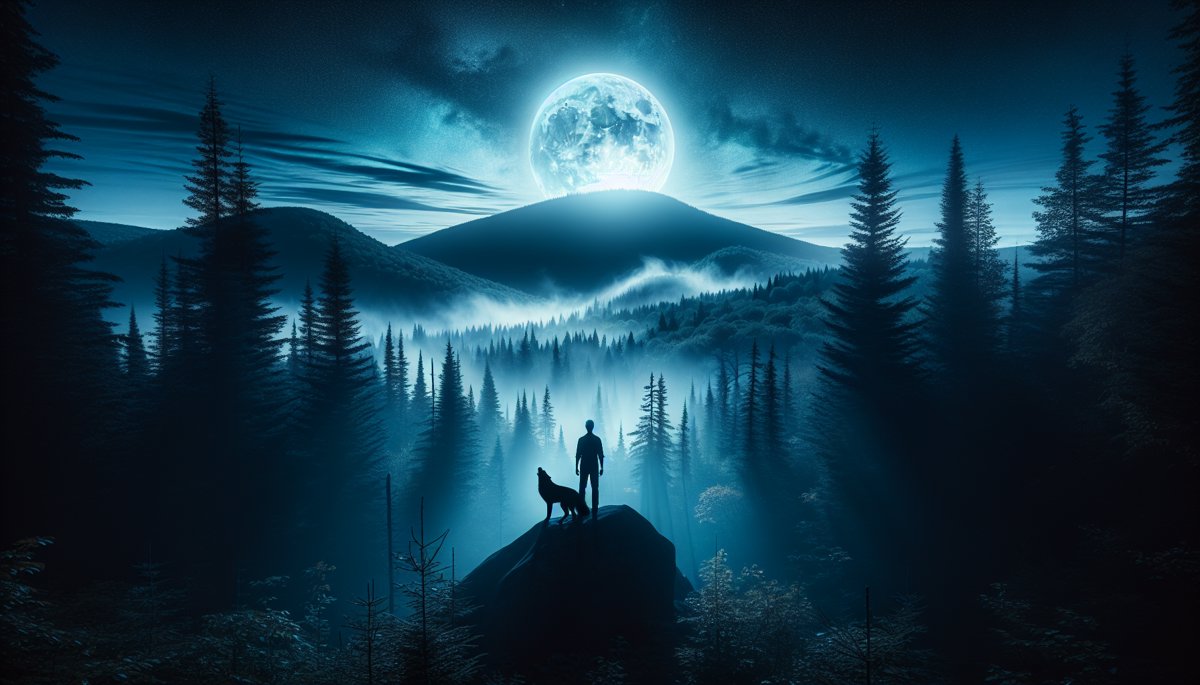
Have you ever heard a pack of wolves howling in the wild?
If you've had the chance to experience this, you might have a good excuse to buy new underwear... No seriously, the thrill is very real, something electric and mysterious emanates from their lament, full moon or not... there's not much that's as frightening as a pack of wolves howling in the darkness.
There's no shame in admitting your fear. The fear of wolves has been in human imagination for a long time. Bloodthirsty beast, fantastic or simply harmful, humans have always had a biased perception of this animal with many qualities.
As Halloween approaches, and also to spare you some discomfort in the crotch region the next time you hear these howls alone in the deep woods, I'm lifting the veil on one of the most mysterious inhabitants of our forests.
A bit of history
Humans would have domesticated the wolf 10,000 years before Christ. They appreciated its qualities so much that they made it a very present animal in their lives. In Antiquity, the wolf was a symbol of strength, light and fertility, it's also an animal associated with the creation myth of Rome (the nurturing she-wolf), the cradle of our civilization.
It's with the beginning of Christianity that the image of Canis lupus (no, this isn't the name of a venereal disease, but the Latin designation for wolf) became tarnished. During the Middle Ages, the Catholic Church using the image of innocence of the sheep to evoke human fragility, associated diabolical traits with this bloodthirsty beast that hunts the flock.
This negative image associated with the wolf then took hold of the collective unconscious to spread in folklore and tales where the "Big Bad Wolf" now possesses supernatural powers (like being able to destroy a wooden house with its breath). No wonder we fear it, we've been depicted since childhood as the incarnation of Evil!
In America, many indigenous tribes adopt the wolf as a totem animal. It thus becomes a protector and auxiliary to our Creator God. Indigenous peoples recognize its qualities of intelligence, courage and agility. Unlike the first settlers who continue to consider the wolf as a constant threat, there's really no animosity between the wolf and Amerindian peoples.
Hunting the beast
Unfortunately, the first settlers imported with them the "hatred of the wolf" and continued to consider it as a harmful species, even going so far as to set up decimation campaigns by encouraging the slaughter of wolves. "The Act to encourage the destruction of wolves" voted in 1831 provided monetary rewards to those who brought back wolf carcasses.
Believe it or not, this type of system that encourages the destruction of the species prevailed until 1957! From 1961, these measures "softened" by prioritizing selective slaughter rather than blind annihilation. From 1971, the government ceased the bounty system and took charge of controlling the wolf population, mainly due to pressure from hunters who wanted to protect their ungulate game (yes, that's right, animals with hooves).
Until 1979, the methods used by the government to control the wolf population were mainly trapping and poisoning with strychnine. Although they were denounced to the general public and since very contested afterwards, some municipalities still use incentive policies today to get rid of wolves! This gives you an idea of how deeply this decimation mentality is rooted in the population.
Today, the wildlife ministry puts a lot of effort into changing this negative image associated with the wolf. It studies wolf behavior, cares for animals in difficulty, relocates problematic individuals and does prevention and education work with the population to destroy prejudices concerning this animal with which it's entirely possible to live in harmony.
Wolf distribution in Quebec
Despite all the abuse inflicted on them, there would be about 7,000 wolves in Quebec. Hunted from places where humans live, they reign supreme in the great wild spaces of America, Europe and Asia.
Wolf or coyote?
Often confused with the coyote, the wolf is a bit larger than the latter. The wolf and coyote are however of the same species and by mating, can give birth to perfectly healthy offspring that can reproduce in turn. It's deforestation and climate change that would push more and more wolves to mate with coyotes.
How to identify it
The fur of the Quebec wolf is, more often than not, gray. The fur of some individuals is closer to beige or pale gray and others more dark gray or black. Their coat tends to pale in winter due to the regrowth of short white hairs and become darker in summer. There's also a negligible quantity of white wolves, but they're more present in arctic territories and in Labrador.
The male's weight can vary between 25 and 40 kg and the female's between 20 and 30 kg.
Reproduction
In a pack, only the dominant female will give birth to young. The mating period takes place in February and the gestation period is about 62 days. Birth therefore takes place at the end of April and beginning of May. The pack thus grows by 5 to 7 wolf pups per year.
From the birth of the young, the pack becomes semi-nomadic throughout the summer, until the pups are strong enough to follow the band in its great hunting activities during autumn. The entire pack participates in educating the young.
The wolf is a faithful animal and the members of the dominant couple will remain partners throughout their lives. This association somewhat determines the social structure of the rest of the band.
The pack
Humans tend to display their social qualities that they put forward to prove their evolution, but the organization of the wolf clan demonstrates cooperation qualities that surpass on several levels human competence to help each other, because the wolf doesn't hesitate to sacrifice itself or put its life at stake to preserve balance in the pack.
Pack size usually varies between 3 and 15 individuals and depends largely on the moose population in their territory. In more northern regions, the wolf also hunts deer and caribou. Beaver and hare are sometimes added to its diet especially in winter. Clan size and birth rate are directly proportional to available resources in the territory.
Like humans, the wolf's social structure is hierarchical
The clan is led by a leader, usually a male popular and recognized within the clan for his strength, intelligence, wisdom and the way he shows recognition for acts of loyalty addressed to him. The fact that the alpha male is the father of most clan members reinforces bonds between pack individuals.
The role of the dominant male is to ensure clan cohesion in its survival efforts and if he fails in this task, clan members won't hesitate to designate a new leader. A wolf can therefore become alpha if he wishes or form a new pack with individuals loyal to him.
Competition between clan members is quite healthy, because good leaders are usually wise enough to maintain within the pack a stress-free climate favorable to survival. For example, if other wolves let him serve himself first, it's not uncommon for the alpha wolf to be tolerant with those who approach, because he's aware that cohesion between clan members is important.
Attachment bonds to the leader are reinforced by distinctive behaviors like rubbing muzzles during important events, like separation or the end of a hunt. It's therefore quite easy to distinguish the dominant wolf in a band, because he's the one who receives the most attention.
The dominant wolf will also tend to stare at group members, while subordinate individuals will tend to avoid his eyes fixed on them.
Hunting
The pack travels on average 20 to 30 km daily in winter as in summer. The extent of territories covered by the pack is vast, and can, in certain regions where game is less abundant, reach 1,000 km2, but the average is around 200 to 300 km2.
Wolf hunting techniques are elaborate, but not infallible. It's not because a beast is tracked that the band will manage to kill it. Like many other predators, wolves are opportunistic. Their potential prey are often injured, younger and inexperienced.
Scientific observations suggest that the band first tracks prey by scent, but it also happens that they cross their path fortuitously.
Once first visual contact is established, wolves try to evaluate the prey's strength through a sprint of less than 7 km. If the prey manages to outdistance the band within this distance, they abandon the pursuit, judging the adventure too energy-consuming.
However, if the tracking efforts are worth it, the band can thus tire prey by pursuing it for several days before delivering the final attack. Depending on the nature and vigor of the game, topography can also be used by wolves to tire the prey or set an ambush. For example by cornering it against a rock face or tumultuous river.
Unlike humans, wolves hunt to feed themselves and not for pleasure. They use more than 80% of the carcass they consume by alternating phases of gorging and fasting. As an example, an adult moose can feed a band of 5 wolves for about 10 days.
Given the phenomenal strength of its jaws, a wolf can easily be alone to kill a deer or young moose. Although they hunt in packs most of the time, it can happen that individuals hunt alone to take advantage of the best pieces of meat, because according to the hierarchy established in the pack, dominant males and females usually serve themselves first.
Noisy neighbors
Wolves' hunting success hurts their reputation. The presence of ravens (another mythical representative associated by humans with shadow forces), among the most intelligent scavengers, is almost inseparable from that of wolves. They can be seen at carnage sites perched in nearby trees, waiting for all pack members to be satiated. Over time, this relationship has become so close that ravens often manage to feed on carcasses without fear of being chased away.
The wolf plays a key role in our forest ecosystem. Its presence exerts selective pressure on herbivores and thus contributes to flora flourishing. Its presence also helps keep at distance certain predators whose too dense population could harm overall balance.
For humans, the wolf is also a reminder of the importance of doing everything to maintain nature's balance. Hence the importance of trying to better understand it to stop being afraid of it and avoid spreading false ideas and thus eradicate behaviors likely to harm it.
Myths and legends
Amplified by folklore, tales and legends, myths concerning the wolf die hard. Let's try to demystify the most persistent received idea.
Why do wolves howl at the moon?
The idea that wolves howl at the moon has no scientific correlation (even less at the full moon). However, since wolves are mainly active at night, it's therefore normal to associate elements of nocturnal life (like the moon and darkness) with their living habits.
If they raise their heads toward the sky while howling, it's simply to allow sound to travel farther. Howling constitutes a means of communication that can convey information over long distances. Depending on the tone and duration of their lament, wolves can convey a whole range of messages.
It can be a gathering signal, or conversely a warning that invites intruders to leave their territory. The wolf can also form a choir and sing in groups to try to impress a rival wolf band with their numbers.
What to do if you cross paths with a wolf?
Like most wild animals, wolves will instinctively flee human presence. If in certain circumstances they are more curious than usual, hungry or sick, they may risk approaching humans.
However, wolf attacks on humans are extremely rare. But if you happen to encounter one, know that it's mainly how you react that will ensure your safety.
Here are some quick tips that can help you get out of an encounter with a wolf without incident.
1. Make your presence felt. Wearing a bell on your backpack, talking when you walk allows you to warn wild animals of your presence. This usually suffices to keep them at distance and avoid crossing their path fortuitously.
But if you see a wolf and it approaches you, don't hesitate to clap your hands, shout, blow a whistle or strike an object to intimidate it. Wolves are quite fearful of the unknown and any assumed intimidation maneuver is generally effective enough to make them flee. In the vast majority of cases, this encounter should end here, but since you like to scare yourself, you can continue imagining what follows.
2. Stay calm and avoid running. Easier said than done I agree, but it's the basic rule of any encounter with a predator. If despite all your noise, the wolf persists in approaching, it's because it's very hungry and in this case, fear and flight (running) are the two elements that most excite their predator instinct. Even if you're "in top shape," you'll never be able to outrun an animal that can run three days in snow, so breathe through your nose and calm your mind.
3. Avoid staring it in the eyes or turning your back. In wolves, gaze serves to intimidate and staring them in the eyes can be interpreted as a sign of provocation. Unless you're looking for an "exotic little feeling," it's completely forbidden. Try instead to distance yourself quietly from the threat by walking backwards or sideways.
4. Look for shelter and arm yourself with an object to keep it at distance. If the animal persists in following you despite the fact that you're moving away, it's not really a good sign. The most dangerous aspect of the wolf is that it's rarely alone. One of its main hunting techniques consists of encircling its prey to assault it from several angles at once.
You can then think of finding shelter (P.S. Wolves don't climb trees) or back against a tree or rock face to avoid being attacked from behind. You can use a tree branch or your walking sticks to keep it at distance hoping it gets tired of receiving blows to the snout!
In closing, you can console yourself by saying that entering into relationship with a wolf is more often a gift than a nightmare. Because it's above all how you approach this encounter that will give meaning to your experience.
If humans have been so intrigued by this animal since prehistory, it's because it's in a certain way so similar to humans. Its cruel, dominating, social and mysterious side are only the reflection of aspects among the most distinctive of humans.
And if we felt the need to domesticate it to better understand it and despite all these millennia of proximity we still maintain curiosity for its wild nature, it's somewhere the sign that this extraordinary animal teaches us how to better live in balance with nature while we continue to destroy it. And just for that, we must show it more than simple curiosity, we owe it all our respect and admiration.
Sources:
https://www.bonjourquebec.com/
https://www.reportage.loup.org/
25 hikes under 2 hours from Montreal
Distance, elevation, parking and season for each one. The ones we go back to ourselves.
Get the guide
About the author
François Dumaine
Founder of Let's Go Play Outside
A passionate hiker, photographer and content creator, François has been hiking the trails of Quebec and Alberta since 2014. He founded Let's Go Play Outside to give you the information he wished he had before heading out.
Get our best guides
One article per week to level up your outdoor game. No spam, promise.
You might be interested in
🥾 AlexHike.ca: A Website That Left Its Mark on Quebec Hikers
🧭 Bougex.com: When Community Was at the Heart of the Outdoors
10 Amazing Camping Spots You Should Discover



Back to Basics
Breaking In Your Shoes
Complete 3-Day Bivouac Story on the Sentier National in Mauricie: Unforgettable Adventure, Challenges and Discoveries