Lightning Myths: The Most Persistent Myths and Half-Truths About Nature's Fire
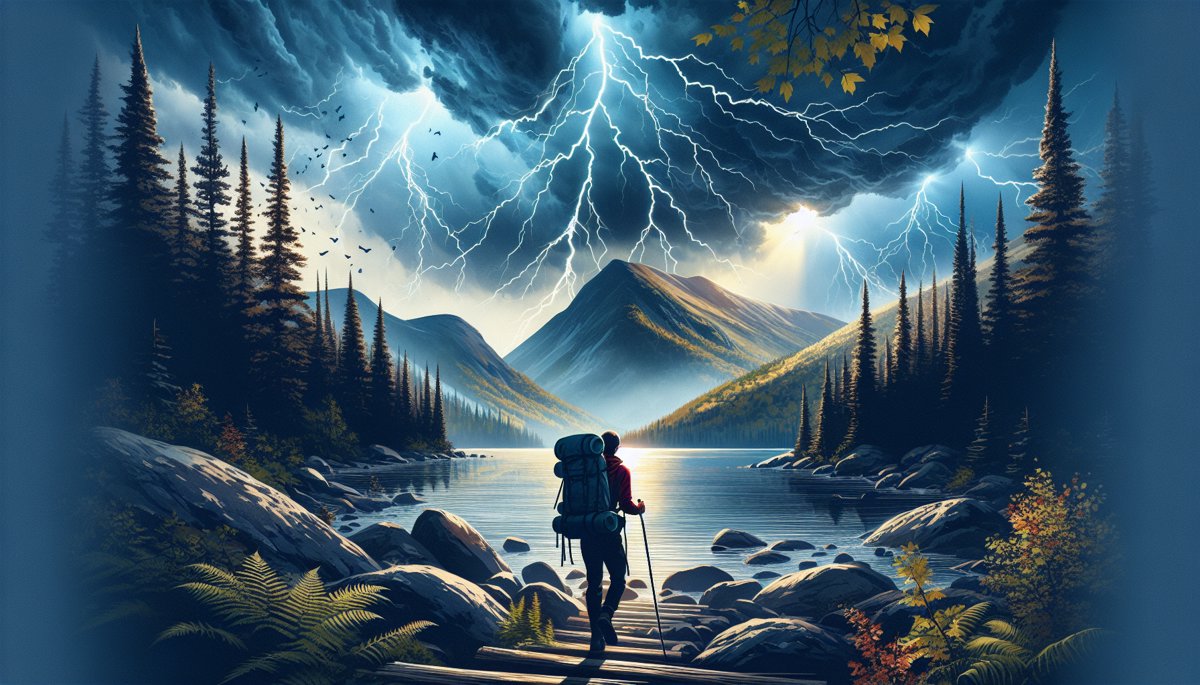
It's striking.
No spectacle is as impressive as a summer thunderstorm. Especially since it can surprise you anytime during one of your favorite outdoor activities.
Because there's risk whether you're on a mountain summit, on a lake, or on a forest trail, it's important to understand how storms form and why lightning can create certain dangers.
In the following text, I shed light on the most persistent myths about storms and the celestial manifestations associated with them.
After this, you'll never again be intimidated by the anger of the "sky gods"...
1. Lightning never strikes twice in the same place...so by staying where it just struck, I'm not at risk.
Myth
This myth persists precisely because there's still a mythical aspect related to this force of nature today. In the absence of logical explanation, humans tend to attribute phenomena they don't understand or understand poorly to chance.
The truth is that, on the contrary, lightning struck a specific location because several factors came together for the phenomenon to occur. There remain reasonable chances that lightning can strike the same place again if the storm cell persists.
Lightning is a natural electrostatic discharge phenomenon that can occur when a large amount of static electricity has accumulated in storm cloud zones, or between clouds or between storm clouds (cumulonimbus) and the ground.
Lightning tends to preferentially strike ground close to the generating cloud, particularly in high-altitude regions, and more specifically buildings and trees, or any prominent objects on land or sea, which can be more precisely targeted by point effect, but also by electrical conduction effects.
We've compiled several data on this phenomenon where in large cities the tallest buildings were struck more than once during the same storm. This is notably the case of the Empire State Building in New York which was reportedly struck 15 times in 15 minutes. The CN Tower in Toronto is struck an average of 75 times per year.
Standing where lightning just struck is assuredly one of the worst things to do.
2. You shouldn't touch someone who was just struck by lightning at risk of being electrocuted too.
Myth
In fact, by acting quickly you can save their life, because lightning can cause respiratory arrest or cardiac arrest and death can follow if no action is taken to resuscitate them.
Here are other symptoms that may indicate a person was just struck by lightning:
Loss of consciousness; confusion, amnesia, coldness, absence of pulse in lower and/or upper limbs, sensory deficit, minor skin burns in feather or branching patterns, hearing loss.
It's also important to be aware that you can be struck by lightning indirectly, for example by having your feet in water while lightning strikes a few dozen meters away.
The first thing to do is check the danger of the location before approaching the person. You must therefore ensure there's no danger nearby (electrical wires, broken glass, sharp objects, tree branches).
You contact 911 as soon as possible. You indicate your geographical position as precisely as possible to emergency services (telling them you're in a sitting position won't really help them).
You check if the person has other injuries and if they're breathing. If not, it's important to administer CPR (cardiopulmonary resuscitation technique). If you don't know this technique, emergency services can guide you through this operation. Don't panic, you'll manage if you keep your calm.
3. Wearing rubber soles protects us against lightning.
Myth
In a storm, the electrical charge that leaves the clouds travels thousands of meters through a thin layer of air to the ground in seconds, it's too powerful (the power of lightning is about 20 GigaWatts, or 20 nuclear power plants!) for a thin layer of rubber to offer an effective protective layer against this force rushing toward the ground.
Unfortunately, car or bicycle tires don't offer any more protection against lightning, well ok except in Back to the Future...
4. In my house or another closed building, I'm protected from lightning.
Myth
Even with windows closed, lightning manages to pass through glass and concrete. Almost all buildings built by humans contain metal, wood or aluminum, materials that are all electrical conductors, so there's a risk of being struck by lightning, even if you're inside a building.
To ensure maximum safety during a storm when you're inside, stay in the center of the building and avoid using running water (bath, dishes), since this constitutes an electrical conductor.
5. By counting the number of seconds between the flash and the thunder, and dividing the result by 3, we evaluate the distance of lightning.
Reality
For example, if 12 seconds separate the flash from the thunder, then the lightning is 4 km away from you.
Another relevant clue to know for evaluating the distance separating you from the storm cell: the farther the storm is, the more thunder is perceived as a rumble. The closer it is, the more it resembles a sharp crack.
Moreover, when lightning is short and straight, the waves are perceived as a single thunderclap. But if the path is long and branched, we then hear a succession of detonations similar to gunfire in a western movie or fireworks.
Knowing how to decode the sounds caused by the storm can allow you to better orient your route to move away from it.
6. There's no danger in using a telephone connected to a landline during a storm.
Myth
Lightning can strike a telephone pole and the charge can travel through the conductive telephone wires and strike whoever is holding the phone. Believe me, there are safer ways to stay "current" with the latest news than talking on a landline phone during a storm!
7. If I'm outside, I can take shelter in a tent, trailer or car and I'll be safe.
Myth and reality
Unfortunately, no shelter is really safe when you're outdoors.
The best way to reduce the risk of being struck by lightning in case of a storm is to act preventively before it occurs. It's therefore important to monitor the weather on Environment Canada's website (or the region where you are) before leaving and even to cancel your activities in case of severe thunderstorm warnings or watches.
It's also important to be attentive to cloud evolution, wind strength and air coolness.
Avoid staying in a field, near a pole, fences or metal objects. Stay away from flooded areas and bodies of water (even streams). If you're navigating on water, reach shore and leave your craft as soon as possible.
If you're on a summit or elevated place, take means to descend in altitude or near the ground. But above all, stay away from trees (especially those that are very tall and isolated).
In the worst case, take shelter in a car (it must not be a convertible) by pulling your feet up to your chest to prevent them from touching the car floor and avoid touching metal objects.
If lightning strikes the car, the metal structure surrounding you will diffuse the intensity of the electrical charge and act as a protective cage thus reducing the chances that you'll be hit.
8. You must stay sheltered for a few minutes after the storm ends.
Reality
About a third of cases of people who were struck by lightning were in a place where there wasn't even rain. We therefore recommend waiting 30 minutes after a storm passes before resuming activities.
9. There's no risk of storms in winter
Myth
Storms can occur in any season, as long as conditions of instability and air humidity are present.
They occur in greater numbers in summer because there's more warm air present in the atmosphere. For a storm to occur, you need both a large mass of cold air and a large mass of warm air. It's very infrequent that a warm air mass large enough to cause a storm is present in winter, but this is possible and more frequent than we think.
In Quebec, between December and April, we can count about ten days with storms. Between 6 and 12 winter storms are recorded annually just in the northeastern United States.
Lightning also strikes during winter storms, but precipitation is mostly in the form of snow and sleet. Winter storms also tend to be shorter and less violent than summer storms.
11. Since a storm is always electrical, it's redundant to say "electrical storm."
Reality
Indeed, all storms are electrical, so it's useless to specify that the "electrical" aspect is present in a storm. It would be like specifying that certain fires are hot, it's useless since by definition fire indicates the production of heat.
12. The probability of being struck by lightning during my lifetime is about 1 in 100 million.
Myth
The probability of being struck by lightning is less than one in a million.
According to Environment Canada, lightning kills between six and twelve people each year in the country and seriously injures sixty to seventy others.
While this statistic seems to indicate that you have as much chance of being struck by lightning in your life as winning the lottery, I'd tell you that the risk increases considerably each time you find yourself outside in nature.
For the accomplished outdoor enthusiast that you are, it's important that you become aware of the risks associated with lightning and that you take measures to avoid these situations in practicing your outdoor activities.
Sources;

25 hikes under 2 hours from Montreal
Distance, elevation, parking and season for each one. The ones we go back to ourselves.
Get the guide
About the author
François Dumaine
Founder of Let's Go Play Outside
A passionate hiker, photographer and content creator, François has been hiking the trails of Quebec and Alberta since 2014. He founded Let's Go Play Outside to give you the information he wished he had before heading out.
Get our best guides
One article per week to level up your outdoor game. No spam, promise.
You might be interested in

🥾 AlexHike.ca: A Website That Left Its Mark on Quebec Hikers

🧭 Bougex.com: When Community Was at the Heart of the Outdoors

10 Amazing Camping Spots You Should Discover





Back to Basics

Breaking In Your Shoes

Complete 3-Day Bivouac Story on the Sentier National in Mauricie: Unforgettable Adventure, Challenges and Discoveries