


Ready to explore Le Colorado Provençal? Here's everything you need to know before you go!
Discover the trail
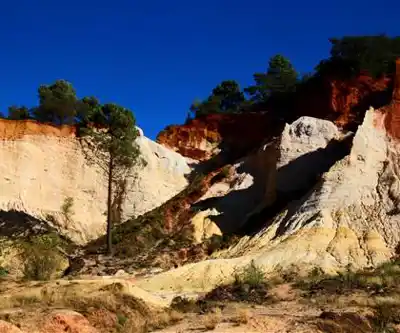
Photos: Guillaume Baviere from Uppsala, Sweden — CC BY-SA 2.0 (Wikimedia Commons)
Trail description
Le Colorado Provençal is one of those places that genuinely stops you in your tracks. The landscape looks like it was lifted straight from the American Southwest and dropped into the Provençal countryside — towering ochre cliffs, sculpted sandstone pillars, and narrow slot canyons in shades of red, orange, and deep yellow.
The site sits near the village of Rustrel in the Vaucluse department (Provence-Alpes-Côte d'Azur region), and the formations themselves are the result of centuries of erosion working through clay-rich, ochre-saturated rock. The result is a maze of badlands, natural corridors, and open amphitheaters that shift color as the light moves across them throughout the day.
What the Trail Actually Looks Like
The trail network at Le Colorado Provençal consists of several interconnected loops, so you can adjust your route based on how much time you have. The main circuit cuts through the heart of the formation and hits the highlights most visitors come for — including the Cheminées de Fées (Fairy Chimneys), a cluster of tall, narrow spires that look almost architectural, and the Cirque de Barriès, a broad natural bowl surrounded by sculpted walls.
The walking surface changes constantly. You'll move from packed earth to loose sand to exposed bedrock within the same stretch of trail. Some sections feel wide and easy, almost like a sandy path through a park. Others narrow down to tight passages between cliff walls, where the rock closes in overhead and the light filters down in thin strips. These slot-canyon sections are some of the most dramatic parts of the hike — and the most photogenic.
The rock walls reach up to 30 meters in places, which gives the formation a real sense of scale that photos don't always capture. Elevation gain varies depending on which loop you choose, with options ranging from shorter circuits to longer routes with 300+ meters of cumulative ascent. Most climbs are gentle inclines, with a few short, steeper pushes leading to viewpoints that open up over the whole formation.
Footing and Conditions
The terrain is rated easy to moderate depending on distance and elevation chosen, and estimated duration varies with route selection. That said, a few things are worth knowing before you go. The clay-rich soil gets genuinely slippery after rain — not just a little muddy, but legitimately tricky underfoot. If there's been recent precipitation, expect to work harder on some sections and watch your step on the descents.
In dry conditions, the paths can be dusty and loose in spots, particularly in the sandy stretches. Sturdy shoes with decent grip make a real difference here. Trail runners or light hiking shoes work well; flat-soled sneakers are less ideal, especially on the rockier sections and near the cliff edges.
The terrain is not accessible for wheelchairs or strollers, and some passages may be challenging for people with significant mobility limitations. For families with kids, the trail is generally manageable, but close supervision is needed near the cliff edges and in the narrower gorges.
Timing and Light
The color of the rock is the whole point here, and the light makes an enormous difference. Early morning and late afternoon are when the ochre formations really glow — the warm, angled light saturates the reds and oranges in a way that flat midday sun simply doesn't. If you're coming specifically to photograph the site, plan your visit around golden hour.
Summer visits work best in the early morning or late afternoon for another reason: the terrain is largely exposed, and midday heat in this part of Provence can be intense. Spring and fall offer the most comfortable conditions overall, with mild temperatures and softer light that suits both hiking and photography. Winter is generally mild enough for a pleasant outing, though frost can make the rocky sections more slippery than usual.
One underrated time to visit: right after light rain, once the paths have had a chance to firm up slightly. The colors of the rock appear noticeably more saturated when the stone is damp, and the air carries the scent of thyme and rosemary from the plants growing in the crevices.
Flora, Fauna, and the Living Landscape
The Colorado Provençal isn't just rock. Aromatic herbs — thyme, rosemary, lavender — grow in the cracks and on the ledges, and on warm days the scent is noticeable throughout the hike. Hardy shrubs and small trees have taken hold in the sandy soil, creating patches of green that contrast sharply with the red and orange rock around them.
Lizards are a constant presence on the sun-warmed surfaces, and raptors are regularly spotted soaring above the formations. The scrubland surrounding the ochre cliffs supports a range of bird species typical of Mediterranean environments. It's a surprisingly alive landscape for something that looks, at first glance, almost desert-like.
Access and Practical Notes
The site is well-signed from Rustrel, with multiple parking areas serving different access points. The main entrance gives the broadest trail access and the best facilities. Parking fills up quickly on summer weekends and holidays — arriving early solves both the parking problem and the heat problem simultaneously.
An entrance fee applies during peak season, with reduced rates for children and groups. Dogs are welcome on leash. There are no water sources within the formation itself, so carry more than you think you'll need — the dry air and potential heat can push your consumption higher than expected.
For photographers, a polarizing filter is genuinely useful here: it helps manage the intense light and brings out the color contrast between the ochre rock and the deep blue sky that's characteristic of this part of Provence.
Recommended gear for this trail


Ready to go?
Everything you need to know before you goWhen?
How much?
- Hiking shoes Essential
- → Salomon Elixir Tour Mid WP · 203.38 $
- Layered clothing Essential
- Rain jacket Essential
- Trekking poles
- → Black Diamond Trail Ergo Cork · 69.99 $
- Headlamp
- → Petzl Actik Core 625 · 103.95 $
FAQ - Frequently asked questions
Everything you need to know
25 hikes under 2 hours from Montreal
Distance, elevation, parking and season for each one. The ones we go back to ourselves.
Get the guideSimilar hikes nearby
Discover other trails you might enjoy

Hiking near Sydney
22 trails to explore ~5031 km away
We work hard to provide the most up-to-date and error-free data possible. If something seems incorrect, let us know! Your contribution helps the whole community.
Hikers' opinions
Be the first to review!
No hiker has shared their experience yet. Share your impressions and help other hikers!