

Ready to explore Cascades d'Orgon? Here's everything you need to know before you go!
Discover the trail
Trail description
The Cascades d'Orgon in Lozère deliver exactly what a waterfall hike should: a trail that earns its destination, terrain that keeps you engaged, and a payoff that makes the effort worthwhile. Tucked into the rugged landscape of Occitanie's most sparsely populated department, this 6-kilometer route threads through forest and rock to reach a series of tiered falls that cascade down granite ledges into cool, moss-rimmed pools below.
The Cévennes region surrounding the Cascades d'Orgon sits within the Massif Central, a genuine ecological crossroads where Mediterranean influences from lower elevations and southern regions meet the harsher, wetter climate of higher mountain terrain. That tension between two worlds shows up everywhere on this trail: in the mix of chestnut, oak, and pine overhead, in the way the vegetation shifts as you gain elevation, and in the dramatic contrast between sun-baked rocky outcrops and the cool, dripping microclimate that surrounds the falls themselves.
The Trail
The route follows an old mule path, the kind of track that once connected isolated communities across these mountains before roads made them redundant. It's a good surface for the most part — packed earth with rocky stretches mixed in — but it asks for attention. Root systems cross the path in the forested sections, and loose stones appear as you move into more exposed terrain. Sturdy footwear is the right call here, not because the trail is dangerous, but because the varied surface rewards proper grip.
The 200 meters of elevation gain over 6 kilometers works out to a comfortable gradient. The ascent doesn't pile up in one punishing section; it distributes itself across the route in a way that keeps the hike feeling manageable throughout. At an estimated 2 hours and 30 minutes round trip, this is a half-day outing that leaves room for time at the falls without rushing the return.
Early on, the trail crosses several small tributaries feeding into the main watercourse. In dry conditions these are simple steps across; after significant rainfall they deserve more care, as water levels can rise quickly in this terrain. The sound of moving water builds gradually as you approach the cascade area, and the air noticeably cools as the mist and shade from the falls begin to reach you — a welcome shift after the climb.
The Waterfalls
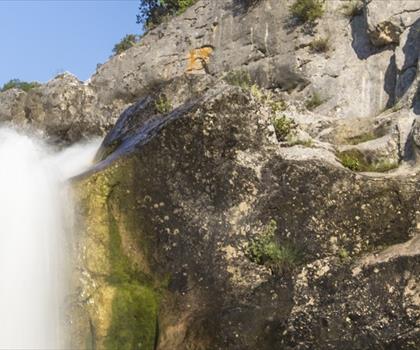
The Cascades d'Orgon aren't a single dramatic drop but a series of tiers, each with its own character. Water moves across granite shelves worn smooth by centuries of flow, dropping into pools that stay cold well into summer. The rock surfaces here show the geological history of the region clearly — striations, weathering patterns, and the kind of fractured granite that speaks to the forces that built the Massif Central over millions of years.
The main drop is the most impressive and the most accessible. Flat granite slabs near the base serve as natural viewing platforms and rest spots; they warm up in the sun and make for a genuinely comfortable place to stop, eat, and take in the scene. The acoustics around the falls are worth noting — the surrounding rock creates a natural amplification effect that makes the sound of the water feel larger than the falls themselves.
Peak flow runs from roughly March through June, when snowmelt and spring rains push the volume up and the spray creates rainbow effects in afternoon light. The largest pool at the base offers the best opportunity for wading, though swimming is limited by the rocky bottom and current in most areas.
Forest and Wildlife
The forest canopy covers most of the route and provides solid shade, which makes this trail a reasonable choice even on warmer days. Chestnut groves dominate the lower elevations — a characteristic feature of the Cévennes landscape — giving way to mixed deciduous and coniferous species as the trail climbs. In autumn, the chestnuts and oaks put on a strong color display. In spring, wildflowers appear on the forest floor and the falls run at their fullest.
Near the waterfalls, the humid conditions support ferns, mosses, and moisture-dependent plants that you won't find in the drier sections of the trail. These spray zones create microhabitats with their own distinct plant communities.
Wildlife is present throughout the area. Wild boar and deer are common, and various smaller mammals use the forest and stream corridor. Bird activity is consistent, with forest species throughout and raptors visible in the more open sections. The noise of the falls can work in your favor here — it masks your approach and sometimes allows for closer observations than you'd expect.
Practical Information
Trekking poles are worth considering, particularly if you're carrying a camera or hiking after rain when the rocky sections near the water become slippery. The trail doesn't require them, but they add stability on the uneven terrain.
Water is available from the stream system along the route. Treat or filter it before drinking, as you would with any natural water source in the backcountry. The falls area stays naturally cool, which is useful for keeping food and drinks at a reasonable temperature during a rest stop.
Weather in this part of Lozère can shift without much warning. Even on a clear morning, it's worth carrying a light rain layer and an extra layer for the falls, where the mist and shade drop the temperature noticeably compared to the rest of the trail.
The trailhead is accessed via narrow mountain roads that require patience, especially when meeting oncoming traffic. Parking is limited, and this destination draws visitors from across the region on weekends and during peak season. An early start solves both problems — you'll find parking more easily and have the falls largely to yourself before the midday crowd arrives.
For photography, the golden hours at either end of the day produce the best light, with the morning sun filtering through the forest canopy and the afternoon angle catching the spray from the falls. A polarizing filter helps manage reflections on the water and brings out the contrast between white water and dark granite.
The Essential Hiking Checklist
Everything you need for your next hike. Bilingual, printable, 1 page.
Get your free hiking checklistRecommended gear for this trail
As an Amazon Associate I earn from qualifying purchases.


Ready to go?
Everything you need to know before you goWhen?
How much?
As an Amazon Associate I earn from qualifying purchases.
Affiliate links — LGPO may earn a commission at no extra cost to you.
- Hiking shoes Essential
- → Salomon Elixir Tour Mid WP · 203.38 $
- Layered clothing Essential
- Rain jacket Essential
- Trekking poles
- → Black Diamond Trail Ergo Cork · 69.99 $
- Headlamp
- → Petzl Actik Core 625 · 103.95 $
FAQ - Frequently asked questions
Everything you need to knowSimilar hikes nearby
Discover other trails you might enjoy
Hiking near Sydney
22 trails to explore ~4886 km away
We work hard to provide the most up-to-date and error-free data possible. If something seems incorrect, let us know! Your contribution helps the whole community.
Hikers' opinions
Be the first to review!
No hiker has shared their experience yet. Share your impressions and help other hikers!